If you are looking for modern examples of Bayanihan, you probably already know the classic image: neighbors carrying a bahay kubo together.
But that picture can make Bayanihan harder to recognize today.
Most of us will never help move a house on bamboo poles. We will, however, encounter classmates falling behind, neighbors recovering from disaster, families without enough resources, customers waiting while one department is overwhelmed, and community problems that become worse because everyone assumes someone else will act.
Bayanihan is still happening in these moments.
The form has changed. The useful question has not:
Where is the load, and how are people choosing to carry it together?
That question gives us a better way to recognize Bayanihan than simply looking for large crowds, dramatic rescues, or acts of generosity.
The Familiar Examples Are Usually the Most Dramatic
Ask students for examples of Bayanihan and many will quickly mention typhoons, floods, volcanic eruptions, donation drives, and the traditional bahay kubo.
Those answers make sense.
Bayanihan becomes easy to see during a crisis because the burden is visible. A house has been destroyed. Families need food. A road is blocked. Someone needs transportation. Relief goods have to reach people quickly.
The need is obvious, so contribution becomes visible too.
The problem is not with these examples. The problem comes when they become the only examples we know.
Then Bayanihan starts to look like something Filipinos practise only when disaster forces us to remember one another.
A student may be able to explain Bayanihan perfectly in an exam yet walk past a shared problem every day without recognizing that the same value could apply.
A team may proudly include Bayanihan in its values while allowing one employee to carry an unreasonable workload because everyone else can say, “Hindi ko naman trabaho iyan.”
We remember the spectacular examples and miss the ordinary moments where culture is actually built.
What Makes Something an Example of Bayanihan?
Before collecting more examples, we need a way to recognize the pattern.
Not every act of helping is Bayanihan. Not every activity involving several people is Bayanihan either.
A useful example usually contains four things.
There is a shared concern. Something matters beyond the convenience of one person.
There is a load. Someone, some group, or something the community values needs support.
There is a useful contribution. People do something that actually helps move the situation.
And there is a shared benefit. The contribution protects, restores, or improves something that matters to more than the helper alone.
You can use that test with every example in this article.
Do not ask only, “Were people helping?”
Ask:
What was the shared concern? Who was carrying the load? What did others contribute? What became possible because they acted together?
That turns Bayanihan from a label into something we can examine.
When Mt. Pinatubo Made Bayanihan Personal for Me
I was in college when Mt. Pinatubo erupted.
What I remember most now is not simply the scale of the disaster. I remember what happened when people started responding.
I rallied classmates. We gathered what we could and brought help to people we did not personally know. None of us had enough resources to make a major difference alone. We were students. What we could offer felt small compared with the destruction around us.
But we moved anyway. (Jef Menguin)
That experience taught me something I have carried for years.
You can feel insignificant when the problem is much bigger than you. The familiar response is to think, What difference can my small contribution possibly make?
Bayanihan changes the question.
Instead of asking whether I can solve the problem, I can ask what part I can carry alongside other people.
That is a very different standard for action.
Nobody in our group needed to become the hero who solved everything. What mattered was that enough people were willing to contribute something useful.
Small does not have to mean useless when contributions connect.
That is also why Bayanihan is closely connected to Move First. The first move does not need to finish the work. Sometimes its job is simply to make participation possible for the next person.
Bayanihan Can Happen in School
Imagine a student who struggles with mathematics.
One classmate understands the lesson well and could simply give the answers. That might help tonight’s homework get finished, but it does little for the struggling student’s ability to solve tomorrow’s problem.
Another classmate responds differently. She spends twenty minutes explaining one concept, works through two examples, then lets her classmate try the next one.
That is a small act. There is no relief operation, no television camera, and probably no certificate of recognition.
But look at the pattern.
There is a shared concern: a classmate is having difficulty learning. There is a load: the learner cannot yet do the work alone. There is a useful contribution: another student gives time and knowledge. And the result increases the learner’s ability rather than replacing it.
That can be an expression of Bayanihan.
Now imagine several students realizing that many classmates have the same problem. Instead of waiting for the teacher to add another remedial session, they create a simple peer-review hour before an exam. Some explain lessons. Others prepare practice questions. Somebody finds a room. Another student keeps track of topics people still find difficult.
The contribution has spread.
This is where helping begins to become collective capability.
It also illustrates an important principle from Help People: useful help does not always mean taking the burden away. Sometimes it means making another person more capable of carrying their part.
A Group Project Can Reveal the Absence of Bayanihan
School also gives us an excellent counterexample.
Five students are assigned one project. Two students do the research, prepare the presentation, design the slides, and rehearse the report. The remaining three appear when the project is almost finished.
Everyone receives the same grade.
Technically, the students completed something together.
But we should be careful about calling that Bayanihan.
Shared membership is not the same as shared responsibility.
One of the shadows of Bayanihan appears when magtulungan tayo really means that the most responsible people will carry everyone else. Eventually those people become tired, resentful, or indispensable, while others learn that someone will rescue the work.
A healthier version would ask what each student can genuinely contribute. One may be good at research. Another can organize the presentation. Someone who struggles academically may still be able to interview people, gather examples, rehearse with the presenters, or help check the final work.
The goal is not equal activity for its own sake.
The goal is useful contribution toward a shared result.
Teachers can use this distinction to make Bayanihan practical. Instead of merely asking students to define the value, ask them to examine their last group project:
Who carried most of the load?
Who could have contributed more?
Where did helping become rescuing?
What would we do differently next time?
That discussion teaches far more than another definition on the board.
Bayanihan Can Happen Between Neighbors
A neighborhood does not need to wait for a major disaster before people can practise Bayanihan.
Imagine a drainage canal that repeatedly clogs. Everyone complains when the street floods. Residents blame garbage collectors. Others blame people who throw trash. Someone says the barangay should fix everything.
There may be truth in several of those complaints. Some responsibilities properly belong to local authorities, and Bayanihan should never become an excuse for institutions to avoid their work.
But residents also have choices.
A few neighbors can document where the blockage occurs. Someone can coordinate with the barangay. Others can help clear what residents can safely remove. Families can agree on what they will stop throwing into the canal. Someone can make the problem visible before the next heavy rain rather than waiting until water has entered homes.
Notice what changed.
The familiar move was complain after the flooding.
The Bayanihan move is identify the shared load, clarify who owns which part, and contribute before the problem becomes heavier.
That is where maagap, malasakit, and Bayanihan begin reinforcing one another.
Bayanihan Can Be Quiet
Some of the strongest examples will never become news.
A family has an elderly member who suddenly needs frequent hospital visits. One sibling cannot keep missing work, so relatives quietly coordinate schedules. One provides transportation. Another handles medicines. Someone prepares meals. A cousin who lives farther away contributes money rather than time.
Nobody carries everything.
The family creates a way to carry the burden together.
Or consider a neighborhood where an older resident lives alone. One person regularly checks whether she needs groceries. Another helps with small repairs. Someone else knows whom to call if there is an emergency.
None of those actions looks spectacular.
Culture rarely does while it is being built.
The point is not that everyone must make themselves available for everybody else all the time. People have limits. Families have responsibilities. Resources are finite.
The point is that belonging changes what we are willing to notice.
Sometimes Bayanihan is not a grand campaign.
It is several people refusing to let one person disappear under a load they can help make lighter.
Bayanihan Can Happen at Work
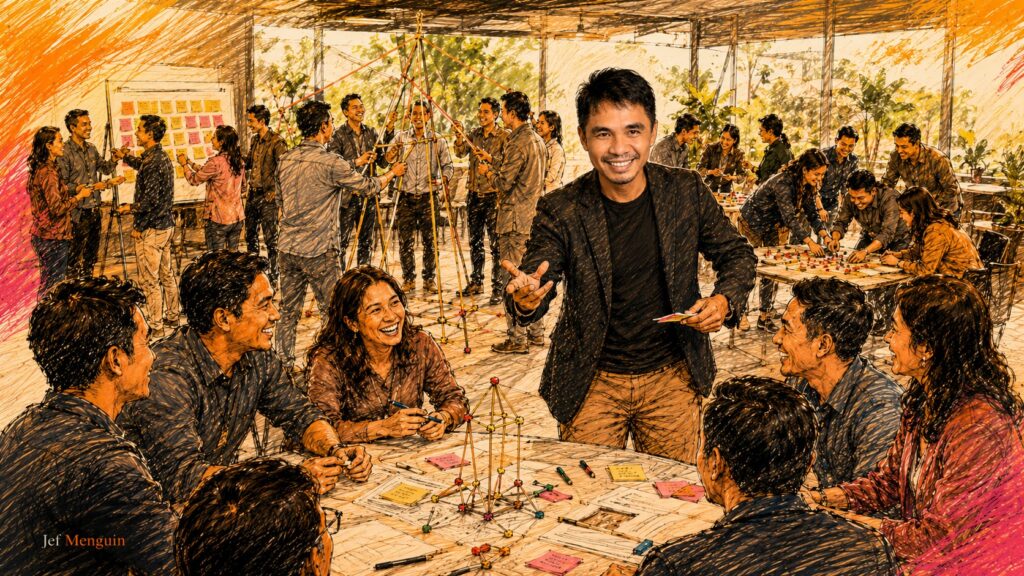
A few years ago, I worked with a company whose customer-service team was drowning during a peak period.
Complaints were accumulating. Agents were getting sick. The chat queue kept growing. By mid-afternoon, their performance board remained red.
Other departments had legitimate reasons to stay out of it. Sales had targets. IT had its own work. HR had responsibilities. Marketing had deadlines.
Customer service was not their department.
Then a supervisor from another part of the organization asked a different question: who could help for a couple of hours if the customer-service team showed them what they could safely handle?
That changed the moment.
Spare headsets were found. Additional workstations were prepared. People from other departments learned how to answer simple inquiries and route cases that required trained agents. The customer-service specialists could then focus on the more difficult problems.
By the end of the day, the board had moved from red to green. (Jef Menguin)
The metric mattered, but there was another result worth noticing.
The overwhelmed team experienced something very human:
They did not leave us alone with the load.
That is Bayanihan at work.
It did not require destroying job descriptions. Nobody announced that responsibilities no longer mattered. People temporarily widened their contribution because the shared customer outcome was at risk.
This distinction is important.
Bayanihan is not “everybody does everybody else’s job.”
It is recognizing when a narrow definition of my work is damaging something that belongs to all of us.
That is also where Bayanihan connects with Make Your Work Matter. Effort becomes meaningful when another person can use the contribution and something important moves because of it.
Bayanihan Can Mean Sharing What You Have
Money is only one form of contribution.
Sometimes the most useful resource is information.
A parent knows which office to contact and helps another parent navigate the process. A student has access to review materials and shares them with classmates. A professional spends an hour helping a community organization understand something within her expertise.
Sometimes the resource is space. A school makes a room available. A neighbor provides temporary storage. An organization lends equipment another group does not have.
Sometimes the resource is access. Someone knows a person who can help and makes an introduction.
Sometimes it is attention. Someone sees a need everybody else has passed.
This matters because people often excuse themselves from helping by thinking, Wala naman akong maibibigay.
Perhaps you do not have money.
That does not automatically mean you have nothing.
Bayanihan asks a more useful question:
What do I have that fits the load?
Bayanihan Can Happen Online
The digital world has created new places for collective action.
People can now organize assistance, share information, connect volunteers, teach skills, coordinate donations, find missing people, and gather support without everyone being physically present in one place.
But digital Bayanihan has a new responsibility attached to it.
Information itself can help or harm.
Forwarding an unverified appeal may feel helpful while sending resources to the wrong place. Sharing an alarming post without checking it can increase confusion during a crisis. Publicly exposing someone who needs help may violate the very dignity we claim to protect.
So the modern move is not simply share.
It is:
Check first. Then share what helps.
Useful contribution still requires judgment.
Bayanihan does not become better merely because it moves faster.
Bayanihan Can Become Good Citizenship
Some examples of Bayanihan begin with helping a person. Others begin with improving something everyone shares.
Students notice that a part of their school is unsafe and bring the concern to the proper people instead of treating accidents as inevitable. Residents organize around a recurring local problem and work with public officials rather than merely posting complaints. Citizens protect public spaces, participate in community efforts, ask questions, and contribute knowledge or time where it can help.
These are not just examples of kindness.
They can become forms of citizenship.
Good citizenship requires more than obedience. It includes participation in the common good.
That does not mean citizens must replace government. Quite the opposite: responsible citizens can contribute while still expecting institutions and officials to perform the work entrusted to them.
Bayanihan helps us avoid two familiar extremes.
One says, “Someone in authority should fix everything.”
The other says, “People should simply help each other, so institutions do not need to improve.”
A healthier question is:
What belongs to the institution, what belongs to citizens, and where can working together make the common good more possible?
You can explore that connection further in The Role of Bayanihan in Filipino Life and Nation-Building and Good Citizenship.
Not Every Act of Helping Is Bayanihan
Calling every kind act Bayanihan makes the word less useful.
Suppose I lend a friend twenty pesos because he forgot his wallet. That is helpful. It does not necessarily require us to describe it as Bayanihan.
Suppose twenty people coordinate to cover up wrongdoing by one of their friends. They are cooperating, but the shared action does not serve a legitimate common good.
Suppose one person performs every task while the rest of the group praises that person’s generosity. There is helping, but there is little shared responsibility.
The label matters less than the pattern.
When you encounter a possible example, use this test:
What matters to us? Who is carrying the load? What useful part did others contribute? What changed for the people who share the outcome?
If those questions reveal only generosity without shared responsibility, call it generosity.
If they reveal teamwork without concern for the common good, call it teamwork.
Bayanihan deserves a more precise meaning.
Find One Example Where You Are
You do not need to search the internet for your next example of Bayanihan.
Look around.
Think about your classroom, workplace, street, organization, family, or online community. Find one situation in which something matters to several people and the load is not being carried well.
Then observe before you act.
Who is carrying most of it now? Who else is affected? What are people already doing? What useful contribution is missing? What could you add without taking over what belongs to someone else?
If you are a teacher, you can turn this into a simple student investigation. Ask students to find one example in their school or community and explain it using four questions:
What was the shared concern?
Who was carrying the load?
What did other people contribute?
What became better because they acted together?
A photograph is not enough. A story is not enough.
Ask for the reasoning.
Students should be able to explain why the situation demonstrates Bayanihan.
That is how we move from memorizing values to learning how to recognize them.
Look for the Proof
A good example of Bayanihan should leave some evidence behind.
The burden became lighter.
Someone who was overwhelmed regained room to move.
A shared task moved forward.
People gained access to something they could not have created alone.
A community recovered faster.
A person became more capable rather than more dependent.
A problem became easier to handle the next time because people learned how to coordinate.
The proof does not have to be dramatic.
It only has to answer:
What became possible because people contributed together?
That question keeps us from romanticizing activity.
Ten people can be busy without moving anything that matters.
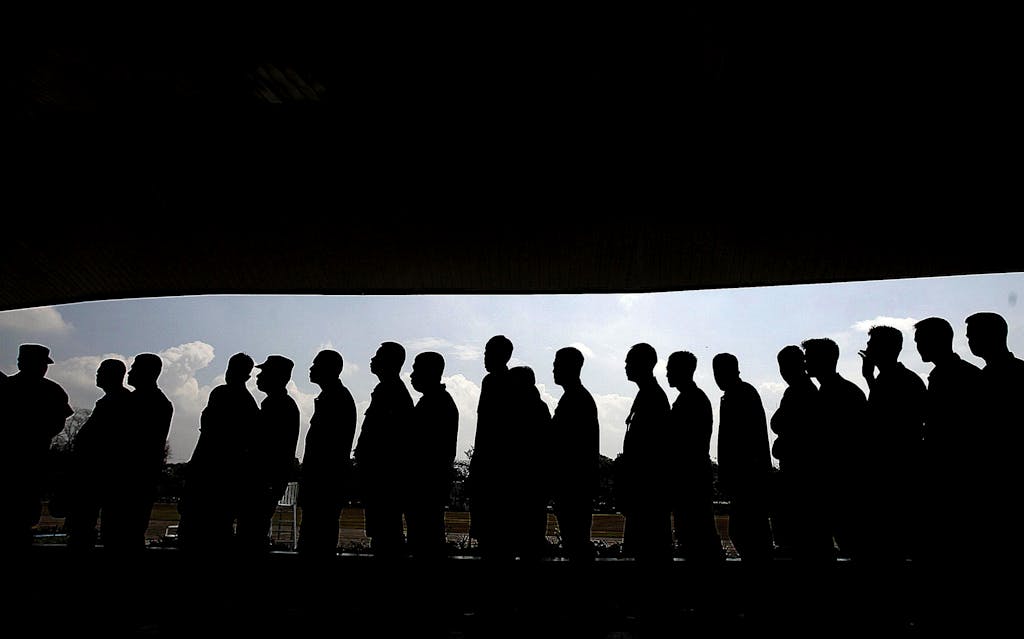
Bayanihan is not proven by the number of people in the photograph.
It is proven by the difference their contributions made.
Modern Bayanihan Is Still Being Written
The examples in this article are not meant to become a definitive list.
That would miss the point.
There are probably thousands of examples happening in Filipino homes, classrooms, workplaces, barangays, organizations, and online communities that will never be published anywhere.
Some are responses to disaster.
Others are so ordinary that the people involved may never call what they did Bayanihan.
That is precisely why we should learn how to recognize the pattern.
A culture survives not because we keep repeating stories about what people did before us. It survives because people discover how to live the value under new conditions.
The bahay kubo may no longer be moving down the road.
The load is still here.
The question is whether we can see it—and whether we will find the part we can carry.
Continue Exploring Bayanihan
For the complete introduction to the value, begin with Bayanihan: The Culture That Turns Ordinary Filipinos Into Heroes.
To understand why Bayanihan matters culturally, read The Cultural Significance of Bayanihan.
For more examples already collected on the site, visit Examples of Bayanihan.
To understand the values that make collective action more likely, continue with Values That Promote the Bayanihan Spirit and the larger Filipino Values collection.
And if you are ready to move from examples to practice, explore 10 Practical Steps to Do Bayanihan Anywhere in the Philippines and Ways to Promote Bayanihan.
How to Cite or Quote This Article
You are welcome to quote or cite this article in research papers, reports, presentations, learning materials, and other educational work.
This article was originally published on January 12, 2026, and substantially updated on August 18, 2026. The original publication date is preserved to show the history of the page, while the updated date identifies the version currently available. (Jef Menguin)
This article presents modern examples as a practical way of examining Bayanihan in everyday life. Some examples are based on personal experience or anonymized workplace situations; others are illustrative scenarios designed to help readers recognize the pattern. They should not be treated as evidence that every Filipino community expresses Bayanihan in the same way.
For academic research, use this article alongside scholarly, historical, and primary sources, particularly when making broader claims about Filipino culture or specific historical events.
APA 7th Edition
Menguin, J. (2026, August 18). Modern examples of Bayanihan: What it looks like today. Jef Menguin. https://jefmenguin.com/modern-examples-of-bayanihan/
For a paraphrase or general reference:
(Menguin, 2026)
For a direct quotation from a section without page numbers:
(Menguin, 2026, “Not Every Act of Helping Is Bayanihan” section, para. 4)
MLA 9th Edition
Menguin, Jef. “Modern Examples of Bayanihan: What It Looks Like Today.” Jef Menguin, originally published 12 Jan. 2026, updated 18 Aug. 2026, https://jefmenguin.com/modern-examples-of-bayanihan/.
Chicago Style
Menguin, Jef. “Modern Examples of Bayanihan: What It Looks Like Today.” Jef Menguin. Originally published January 12, 2026. Last modified August 18, 2026. https://jefmenguin.com/modern-examples-of-bayanihan/.
A Note for Researchers
When citing this page, August 18, 2026 identifies the substantially revised version, while January 12, 2026 identifies the original publication.
The examples on this page are intended to illustrate a practical interpretation of Bayanihan: people recognizing a shared concern and making useful contributions toward a shared good. Use that interpretation as a framework for examining examples rather than as a claim that every cooperative or helpful Filipino behavior should automatically be classified as Bayanihan.
If you want Filipino values to show up as real behavior at work…
Let’s turn it into a culture shift experience.
→ Shift Experiences
