Start Here
You may be exploring Supervisor Factor™ for different reasons.
Choose the path that fits your question.
I want to understand the problem.
See why many supervisors stay busy but do not create the shifts their teams need.
See What Keeps Supervisors Busy
I want to choose the right path.
Compare Start Supervising for newly promoted supervisors and Supervisor Effect for practicing supervisors.
I want to see how the method works.
Learn how stuck moments become Minimum Lovable Plays supervisors can practice and repeat.
I want to explore this for my organization.
Tell me what is happening with your supervisors, and we can identify the best starting point.
The present game keeps supervisors busy.
In many workplaces, supervisors are expected to keep things under control.
So they remind people, answer every question, fix small mistakes, attend meetings, follow up again and again, and absorb pressure from both sides.
From the outside, that looks responsible.
But inside the team, something else happens.
People wait. Commitments stay unclear. Problems return. Meetings become routine. The supervisor becomes the reminder system, the fixer, the messenger, and the pressure absorber.
That may keep work moving for a while.
But it does not help the team win.
A team does not win because the supervisor carries more. A team wins when people understand the work faster, own their commitments, solve problems earlier, and move without being chased.
That requires a new game.
Supervisor Factor helps supervisors stop playing the game of control and start playing the game of movement.
From reminding people again and again to making commitments visible. From fixing every mistake to coaching the next better action. From running meetings to leading huddles that create action. From carrying pressure alone to building ownership across the team.
This is how supervisors stop surviving the role.
They start playing to win.
Choose the supervisor game you need to win first.
New supervisors need a clean start.
They were promoted because they knew the work. Now they must lead people who used to stand beside them. Every instruction, decision, and silence now carries weight.
They cannot guess their way into supervision. They need to step into the role.
Practicing supervisors need a stronger effect.
They may already attend meetings, answer questions, fix problems, and follow up. But if work stays unclear, commitments disappear, feedback comes late, and huddles do not create action, effort is leaking.
They do not need another reminder to “lead better.” They need plays that change what happens at work.
That is why Supervisor Factor begins with two core programs.
Start Supervising
For new supervisors who must stop guessing and start leading.
Start Supervising helps newly promoted supervisors understand what changed when they accepted the role.
They learn how to lead former peers, set expectations, use fair authority, give clear direction, and build their first supervision rhythm.
This is where new supervisors stop acting like promoted employees and start playing the supervisor game.
Supervisor Effect
For practicing supervisors who must turn daily supervision into daily wins.
Supervisor Effect helps supervisors practice the plays that move people, work, and results.
They make work clearer and commitments visible. They lead huddles that create action. They give feedback earlier. They coach the next step. They repair trust before silence grows.
They do not only learn the ideas. They use the tools, run the plays at work, and show proof that something changed.
This is where supervisors stop surviving the role and start playing to win.
The 10 Supervisor Workshops
Supervisors do not need ten more topics to remember.
They need practical plays they can run at work. Each workshop provides them two to four plays they can use at critical moments.
Each play gives supervisors one clear move, one useful tool, and one visible win.
1. Own the Role
Stop waiting. Start supervising.
This play helps new supervisors step into the role with clarity, fairness, and courage.
They learn what changed when they became supervisors, how to lead former peers, and how to use authority without acting like a tyrant or hiding like a friend.
Win: The supervisor accepts the seat and leads with confidence.Feedback comes too late.
2. Give Clear Direction
End confusion before work begins.
This play helps supervisors make the outcome, standard, owner, deadline, and next step visible.
No more “I already told them” when people still do the wrong thing.
Win: People know what good work looks like and what must happen next.
3. Focus the Team on Results
Stop reacting to everything.
This play helps supervisors separate noise from the work that truly moves results.
They learn to protect attention, name the vital few, and help the team move toward what matters.
Win: The team stops being busy and starts moving.
4. Delegate with Trust
Stop carrying the work alone.
This play helps supervisors pass work without dumping it, abandoning people, or grabbing it back too soon.
They learn to define the win, give support, set checkpoints, and build ownership.
Win: The supervisor carries less. The team owns more.
5. Build Follow-Through
Stop chasing people.
This play helps supervisors turn promises into visible commitments.
They learn to make owners, deadlines, proof, and next steps clear, so follow-through does not depend on memory, mood, or repeated reminders.
Win: Commitments stop disappearing.
6. Improve Through Feedback
Say what helps performance improve.
This play helps supervisors give feedback early, clearly, and usefully.
Not as an attack. Not as a delayed sermon. Not as a surprise during evaluation.
Win: Small issues improve before they become big problems.
7. Coach the Next Step
Stop correcting only the mistake.
This play helps supervisors turn performance gaps into the next better action.
They learn to coach one rep, one behavior, one improvement at a time.
Win: People know how to improve, not just what they did wrong.
8. Build Daily Trust
Repair trust before silence grows.
This play helps supervisors notice small tension, handle it early, and create honest conversations before people shut down.
Trust is not built by posters. It is built in daily moments.
Win: People speak up sooner and work with less fear.
9. Make Better Decisions
Stop guessing. Stop delaying.
This play helps supervisors decide with clearer judgment.
They learn to define the real issue, weigh options, consider fairness, and choose the move that serves the team and the work.
Win: Work moves because decisions move.
10. Lead Better Huddles
Stop talking. Create action.
This play helps supervisors turn short meetings into movement.
They learn to use huddles for clarity, ownership, blockers, priorities, and next steps.
Win: The team leaves the huddle knowing what to do, who owns it, and what happens next.
You do not need to start with all ten.
Start with the play that removes the biggest drag on the team.
That is where the next win begins.
The supervisor is closer to the problem than anyone else.
You can have a strong strategy.
You can have clear company values.
Good policies.
Smart managers.
Expensive systems.
A beautiful training calendar.
But on Monday morning, people do not experience the company through the strategy deck.
They experience it through their supervisor.
When work is unclear, the supervisor is there.
When commitments disappear, the supervisor is there.
When feedback is avoided, the supervisor is there.
When tension starts to grow, the supervisor is there.
When the team is waiting, guessing, or quietly giving up, the supervisor is usually close enough to notice.
That is why the supervisor matters.
Not because the supervisor controls everything.
But because the supervisor touches the work every day.
A supervisor can turn one instruction into clarity. One huddle into action. One follow-up into ownership. One feedback conversation into improvement. One tense moment into trust.
Or the supervisor can let the same small problems repeat until they become “culture.”
That is the part many organizations miss.
Culture is not only shaped in executive meetings. It is shaped in the daily moments supervisors handle or avoid.
So when you strengthen supervision, you are not just developing people.
You are changing what the team experiences every day.
That is why we say:
The supervisor is the factor.
Not the only factor.
But often the one close enough to change what happens next.
Where does supervision break down first?
Supervisor problems rarely arrive wearing one label.
They show up as missed deadlines, repeated reminders, quiet employees, unclear work, slow decisions, weak huddles, and managers asking, “Why do I still need to chase this?”
That is why we do not begin with a long list of training topics.
We begin with the stuck moment.
Find the moment that feels most familiar.
New supervisors hesitate.
They were promoted because they were good at the work. But now they must lead people who used to stand beside them.
They do not want to sound bossy. They do not want to lose friends. They do not know how to use authority without damaging trust.
The workshop: Own the Role.
Instructions get repeated.
The supervisor already explained the task. The team nodded. Everyone seemed to understand.
Then the work came back late, incomplete, or wrong.
The workshop: Give Clear Direction.
Commitments disappear.
People say yes in the meeting. They agree in the chat. They promise to follow through.
But nothing moves until the supervisor asks again.
The workshop: Build Follow-Through.
Huddles become announcements.
The team gathers. Updates are given. Reminders are repeated.
But after the huddle, people still leave without clear ownership, next steps, or movement.
The workshop: Lead Better Huddles.
Feedback comes too late.
The supervisor notices the issue early but waits. Maybe it will fix itself. Maybe the timing is not right. Maybe the person will feel bad.
Then the small issue becomes a bigger problem.
The workshop: Improve Through Feedback.
Tension becomes silence.
Something feels off. People avoid eye contact. Questions stop. Honest conversations disappear.
The team looks peaceful, but trust is leaking.
The workshop: Build Daily Trust.
Decisions keep getting delayed.
The supervisor waits for more information, more approval, or more certainty.
While everyone waits, work slows down.
The workshop: Make Better Decisions.
The supervisor carries too much.
It feels faster to do the work than to delegate it.
But when the supervisor carries everything, the team learns to wait instead of own.
The workshop: Delegate with Trust.
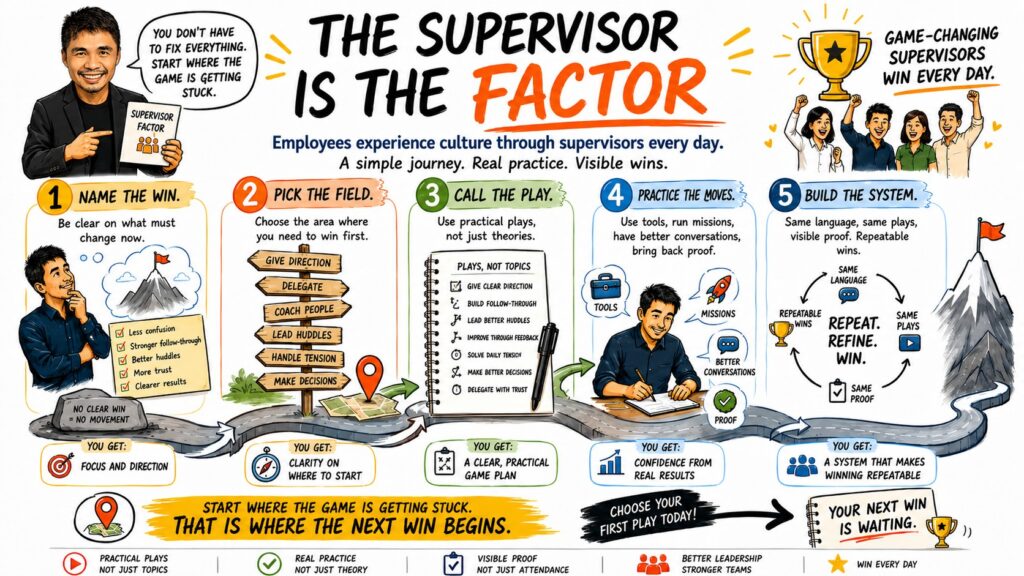
You do not need to fix everything at once.
Start where the game is getting stuck.
That is where the next win begins.
How does Supervisor Factor work?
Supervisor Factor is not one seminar.
It is a system.
It helps supervisors move from pressure to practice. From scattered effort to clear plays. From “I hope they apply this” to visible proof that something changed at work.
The journey is simple.
First, name the win.
What must change now? Less confusion. Faster follow-through. Stronger huddles. Earlier feedback. More ownership. Better trust. Clearer results.
A supervisor cannot play to win if the win is foggy.
Second, pick the field.
Where does the supervisor need to win first? In giving direction? Delegating work? Coaching people? Leading huddles? Handling tension? Making decisions?
You do not need to fix everything at once. Choose the field where movement matters most.
Third, call the play.
A topic is something people discuss.
A play is something supervisors practice.
So we do not stop at “communication.” We call the play: Give Clear Direction.
We do not stop at “accountability.” We call the play: Build Follow-Through.
We do not stop at “meetings.” We call the play: Lead Better Huddles.
Fourth, practice the moves.
Supervisors use tools, run workplace missions, try better conversations, and return with proof.
The confidence does not come from theory.
It comes from reps.
Finally, build the system.
When supervisors use the same language, practice the same plays, and show the same proof, the organization gets more than training.
It gets a way to make winning repeatable.
What Are Minimum Lovable Plays?
Supervisor Factor™ does not stop at topics.
A topic is something supervisors discuss.
A Minimum Lovable Play is something supervisors can run in one real workplace moment.
It is small enough to use on Monday. It is useful enough to repeat. It is practical enough to improve through practice. And it is clear enough to show proof that something changed at work.
That matters because supervisors do not change the game through big ideas alone.
They change the game in moments.
When instructions are unclear.
When commitments disappear.
When huddles become announcements.
When feedback comes too late.
When trust starts to leak.
When the supervisor carries work the team should own.
A Minimum Lovable Play gives the supervisor a better move for that moment.
It has five parts:
Moment. Moves. Tool. Practice. Proof.
The moment tells us where the supervisor game gets stuck.
The moves show what the supervisor can do differently.
The tool makes the move easier to use.
The practice helps the supervisor run the play in real work.
The proof shows whether something changed.
That is why Supervisor Factor™ is different from generic supervisory training.
We do not only ask, “What should supervisors know?”
We ask, “What play can they run when the moment comes?”
Download the Visual Guide: What a Minimum Lovable Play Is
Want to see how Minimum Lovable Plays work?
Download the visual guide. It explains why an MLP is not a tip, not advice, not a module, and not a small course. It is a small play people can use in one real moment.
You will also see the five things every MLP needs:
Moment. Moves. Tool. Practice. Proof.
What a Supervisor Factor experience looks like
Let’s take one common supervisor moment.
A supervisor says, “I already told them.”
And the supervisor may be right.
The instruction was given. The reminder was sent. The team nodded. Everyone seemed to understand.
Then the work came back late, incomplete, or wrong.
In many training programs, this becomes a communication topic.
In Supervisor Factor, we turn it into a play.
First, we name the pattern.
The supervisor is explaining the task, but the work is still not clear enough to act on. The problem may not be laziness. It may not be attitude. It may not even be lack of effort.
The problem may be that the instruction was heard but not made visible.
So we teach the shift:
Clear work is not explained once. Clear work is made visible.
Then supervisors practice the move.
They define the outcome. They show the standard. They name the owner. They set the deadline. They agree on the next step. Then they check understanding before the work begins.
After that, they use the play in real work.
Not someday.
Not after the program.
In the next huddle. The next assignment. The next chat message. The next quick conversation before work starts.
Then they return with proof.
What instruction did they change?
What tool did they use?
What happened after they made the work clearer?
What will they repeat next time?
That is the difference.
Supervisor Factor does not end with “I learned something.”
It asks for proof that something changed.
Because the real win is not a happy evaluation form.
The real win is when work moves differently on Monday.
Who Supervisor Factor is for
Supervisor Factor is for organizations that know supervision is not a small role.
It is for HR leaders, L&D managers, operations heads, and business owners who see the same problems coming back again and again: unclear work, weak follow-through, delayed feedback, quiet tension, poor huddles, and supervisors carrying too much pressure alone.
It is for companies with new supervisors who were promoted because they were good at the work, but now need to lead people.
It is for practicing supervisors who already attend meetings, answer questions, fix problems, and follow up, but still need stronger plays for clarity, accountability, coaching, trust, and performance.
It is for managers who want a common supervisor language across teams.
Not one supervisor doing it this way, another doing it that way, and everyone depending on personality.
A common language. A common set of plays. A common way to show proof that supervision is improving.
Supervisor Factor is also for organizations tired of training that ends with attendance.
If your standard is only “people enjoyed the session,” this may feel too practical.
But if your standard is, “What changed at work after the session?” then this system will make sense.
Because Supervisor Factor is built for movement.
Not more topics. Not more slides. Not another certificate.
Movement in how supervisors give direction, build ownership, run huddles, give feedback, repair trust, and help people do better work.
That is the work.
And for many teams, that is where winning begins.
Bring Supervisor Factor into your organization
Start with the supervisor problem that costs you the most.
New supervisors still guessing?
Start with Start Supervising.
Supervisors busy but not creating movement?
Start with Supervisor Effect.
One problem hurting the team right now? Start with one Supervisor Play: clearer direction, stronger follow-through, better feedback, daily trust, sharper decisions, or huddles that create action.
You do not need the perfect path today.
You need the first useful win.
In a Supervisor Factor Shift Call, we look at where supervision gets stuck, choose the first play, and decide the right entry point for your organization.