People do not always remain still because they do not care. Sometimes they are waiting for someone to show that movement is possible. Move First helps you recognise the move that belongs to you, make contact with reality, and create the first proof that something can change.
Make the first move toward what matters
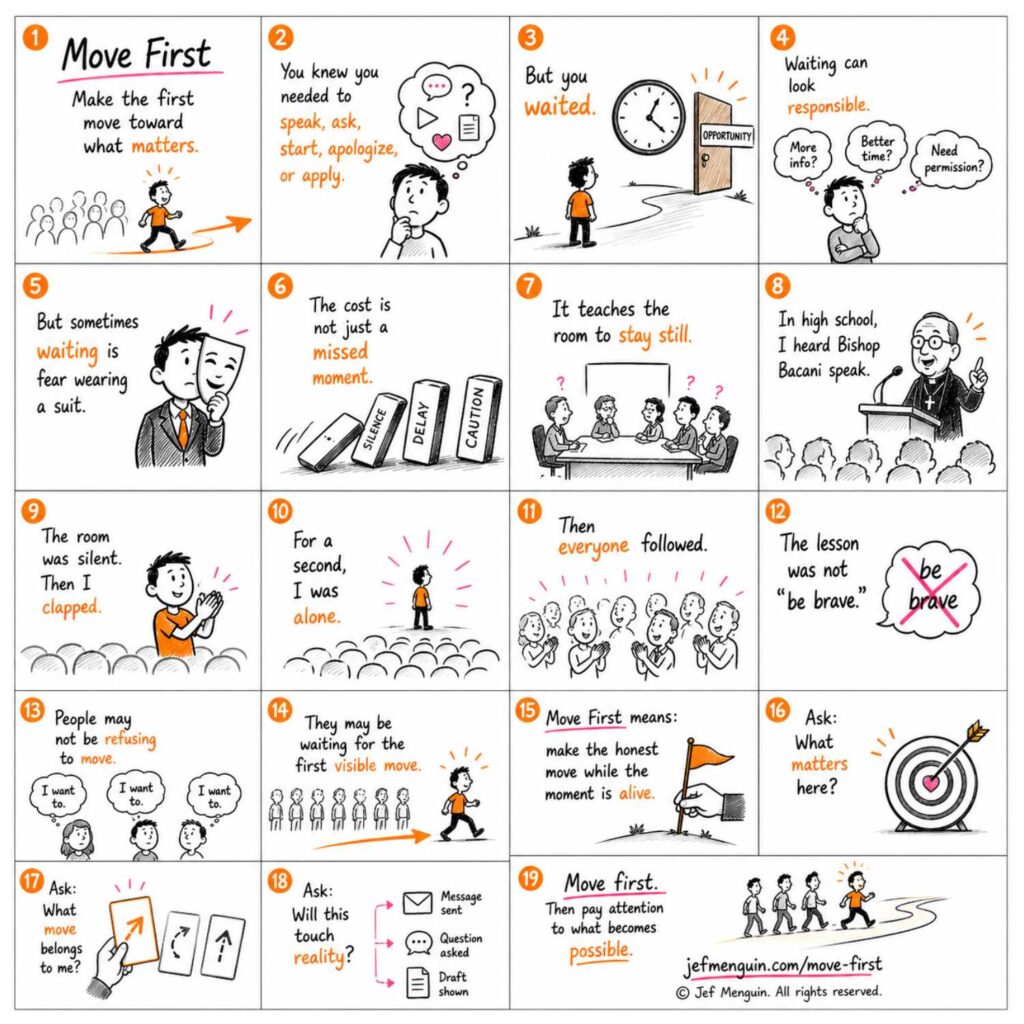
When was the last time you knew you needed to do something but allowed the moment to pass?
Perhaps you wanted to speak during a meeting, offer an idea, apologise, ask for help, begin a project, or apply for an opportunity. You did not decide that it was unimportant. You simply waited. Then the day ended, the conversation moved on, or the opportunity quietly became part of the past.
Some missed moments are easy to forget. Others return months or years later because we know the first move was ours to make. We wonder what might have happened had we acted while the door was still open.
People do not always remain still because they do not care. We may care deeply and still wait. We look for confidence, clearer instructions, a better time, or evidence that somebody else is willing to begin. While everyone is watching everyone else, the moment disappears.
The cost is not limited to one missed opportunity. Repeated waiting can teach us to distrust our ability to begin. It can also teach the people around us that silence, delay, and caution are the safest responses whenever something unfamiliar needs to happen.
I discovered another possibility when I was still in high school.
The first clap
I was in third-year high school when hundreds of students were invited to a school in Antipolo for a leadership seminar. The speaker was Bishop Bacani. He was still young then, and he was one of the most dynamic speakers I had ever seen.
It was the first time I had watched a speaker who was that good. Perhaps everyone was silent because he spoke about spiritual and serious matters. Perhaps we were not accustomed to applauding in the middle of a seminar. Or perhaps he held our attention so completely that nobody wanted to interrupt him.
He said many things that resonated with me. At one point, I could no longer contain my response, so I clapped.
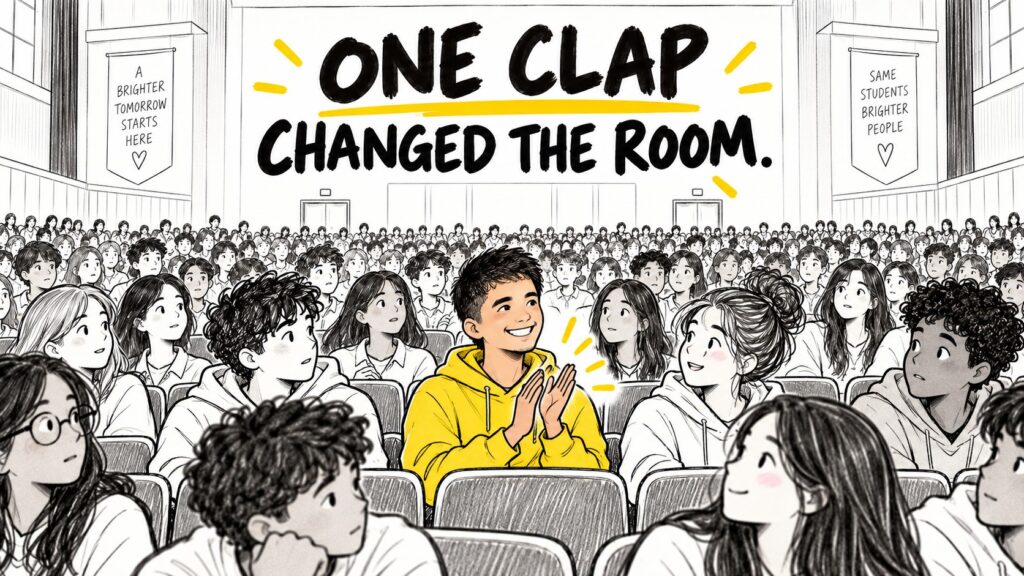
For a brief moment, my clap was the only sound in an auditorium filled with hundreds of students. Then everyone joined me.
Bishop Bacani continued speaking. Later, he made another powerful point, and I clapped again. The crowd followed. It happened a third time, but by then something had changed. I was no longer the only person beginning the applause. The other students had learned that they could respond, and they no longer needed to wait for me.
It was as though the auditorium had learned how to clap.
I do not know whether everyone had wanted to clap from the beginning. Perhaps they were waiting for permission. Perhaps each student looked at everyone else and concluded that silence was expected. Perhaps nobody wanted to be the first person whose applause echoed alone across the auditorium.
What stayed with me was that I had not planned to lead the crowd. I was not someone who always made the first move. In many situations, I also waited for other people to begin.
That clap surprised me too.
It became a discovery I would recognise many times later. Years after high school, I found myself in smaller rooms with adults, managers, professionals, and leaders. Sometimes there were only twenty people listening to a speaker. The speaker would make an important point, yet the room would remain quiet.
I would clap, and others would follow.
The first mover risks looking foolish. But the first mover also makes movement visible.
People may be waiting for the first visible move
The lesson I carried from that auditorium was not merely that one person should be brave enough to clap.
It was this:
People may not be refusing to move. They may be waiting for the first visible move.
This happens because we use other people’s stillness as evidence. When nobody speaks, we assume silence is expected. When nobody questions the familiar practice, we assume everyone accepts it. When nobody offers help, we conclude that helping may be unwelcome.
Then everyone waits for the same evidence that nobody is willing to create.
The first move interrupts that pattern. It tells the room that another response is possible. It may not persuade everyone, and it does not guarantee that others will follow, but it replaces imagined reactions with something real.
That is what it means to Move First.
Move First is the practice of making the first honest move toward what matters instead of waiting for complete confidence, perfect conditions, permission, or another person to begin.
It is not about being loud, impulsive, or eager to attract attention. It is not about forcing people to follow you or acting as though your idea must be right because you acted first. It is about recognising the move that belongs to you and making it while the moment is still alive.
Why the first move changes the situation
A first move can appear small, but it changes the situation in several important ways.
First, it breaks the waiting pattern. Before the first clap, every student could use the silence of hundreds of others as a reason to remain silent. After the first clap, silence was no longer the only available response.
The same pattern appears in organisations. A team may know that a recurring meeting wastes time, but nobody questions it because the meeting has always been conducted that way. The first person who asks, “What decision must we make before this meeting ends?” changes what the team can discuss. The question does not solve everything, but it breaks the agreement to continue without examining the practice.
Second, the first move creates information. Before you move, you deal mostly with predictions. You imagine how people may react, what could go wrong, or whether the idea will work. After you move, reality answers.
Someone responds to your message. A customer questions your assumption. A colleague improves your draft. A person declines your invitation. Even rejection tells you more than silent preparation ever could.
Third, the first move lowers the threshold for the next move. The first clap is difficult because it has no precedent. The next clap is easier because someone has already shown that applause is possible. A first draft gives people something to improve. One honest question gives others language for a conversation they did not know how to begin.
Finally, the first move changes the mover. You discover that uncertainty does not have to disappear before you act. You learn that confidence can grow from completed attempts, useful responses, and mistakes you survived.
You do not always become ready and then move.
Sometimes you move, and the movement makes you readier.
Waiting can look responsible
Not every delay is avoidance. Some decisions require careful thought, consultation, or expertise. When other people’s safety, livelihood, privacy, or trust are involved, moving responsibly matters more than moving quickly.
But waiting can also disguise itself as responsibility.
You may say that you need more information even though another hour of research will not change the next sensible step. You may say that you need confidence when what you actually fear is being the only person in the room willing to speak. You may say that you need permission without identifying who must grant it or why it is required.
Preparation becomes postponement when it no longer improves the move. It merely protects you from being seen making it.
This is why beginning before you feel ready does not mean abandoning judgment. It means recognising when the next lesson is available only through action.
The first honest move
Not every action creates movement.
You can spend hours choosing tools, arranging files, studying possibilities, and improving plans while keeping the real work safely away from reality. The activity may be related to your goal, but the situation remains unchanged.
A first honest move produces contact with the real world. It creates something, asks something, tests something, changes something, or allows another person to respond.
It is honest because it stops pretending that thinking about the move is the same as making it.
To identify a first honest move, ask four questions.
What matters here?
Movement becomes useful because of the direction it serves.
Before acting, name the person, promise, contribution, or result involved. What are you trying to make happen? What should become different? Why does it deserve your attention now?
Suppose you want your team to become more open during meetings. “Speak more” is not yet a clear purpose. Perhaps what matters is that concerns affecting customers are raised early enough to be addressed. That gives the move direction.
Without this clarity, moving first can become another form of busyness. When too many concerns compete for your attention, Choose What Matters helps you decide which one deserves movement now.
What move is yours to make?
You do not need to control the entire situation before you can influence it.
A staff member may not have the authority to redesign a company process. But she may be able to document where the process repeatedly fails, speak with the people affected, and propose a limited experiment.
A parent cannot force a child to become open. But the parent may be able to listen without interrupting, correcting, or turning every story into a lesson.
A colleague cannot manufacture appreciation across an organisation. But he can recognise one person’s contribution precisely. Instead of saying, “Good job,” he can say, “The way you clarified the customer’s concern prevented another round of confusion. That helped the team move.”
Moving first does not mean carrying responsibilities that belong to others. It means refusing to use what you cannot control as an excuse for ignoring what you can do.
Ask yourself:
What is the move that belongs to me?
Can I make it now?
A first move should be possible with the resources, knowledge, influence, and time you already have.
If it requires six free months, a large budget, complete confidence, or everyone’s cooperation, you may have described the final result instead of the beginning.
Writing a book may begin with one useful page. Building a business may begin with one conversation with someone who experiences the problem. Repairing a relationship may begin by requesting time to talk and preparing yourself to listen.
The first move may be small in scope and still emotionally difficult. Sending one honest message may require more courage than writing a twenty-page plan that nobody will ever see.
Small does not mean painless.
It means possible.
Will it create contact with reality?
A first honest move leaves evidence.
Opening a document is not yet writing. Saving an application form is not submitting it. Thinking about whom to call is not making contact. Telling yourself that you appreciate someone is not the same as telling the person.
After a real move, something exists that did not exist before. A paragraph has been written. A message has been sent. A question has been asked. A date has been requested. A draft has been shown. Someone has received help.
More importantly, reality now has an opportunity to respond.
That response may confirm your direction, challenge your assumption, or reveal that you have been repeating an old pattern. When the same move keeps creating the same unwanted result, it may be time to Change Your Game rather than increase your effort.
The first move does not need to answer every question.
It needs to give you a more truthful question.
Moving first in everyday life
The practice becomes clearer when we stop treating it as a dramatic act reserved for leaders on a stage.
Suppose you want people to listen to you in meetings. Your first move may not be to speak louder or insist that people respect your turn. It may be to listen closely to one person, summarise what you heard, and ask whether you understood correctly. When people experience being heard, the conversation changes. Listening first does not guarantee agreement, but it creates the conditions where disagreement can become useful.
Suppose you want a culture where people care for one another. The first move may be as simple as noticing someone who has become invisible. You greet the security guard by name. You ask a colleague who has been quiet whether something is making the work difficult. You follow up after a teammate mentions a family concern.
Care becomes credible when it is visible in specific behaviour.
The point is not to perform kindness so other people will reward you. The point is to stop waiting for the culture you want and begin showing what it looks like.
Make one move before tomorrow
An article about moving first should not leave you with information alone. It should lead to movement.
Think of one situation you have been postponing even though it continues to matter. Do not choose ten situations. Choose the one that keeps returning to your attention.
First, name what matters. Complete the sentence: “This deserves movement because…” Identify the person, promise, result, or change involved.
Next, name what you are waiting for. Complete the sentence: “I have been waiting for…” It may be confidence, approval, more information, a better schedule, or someone else’s example.
Then identify the move that belongs to you. It should be possible with what you have and real enough to create contact with another person, the work, or the situation.
Finally, decide what will count as first proof. The proof may be that the message was sent, the question was asked, the page was completed, or the conversation was scheduled. It may also be a response that helps you choose what to do next.
Make the move within the next twenty-four hours, unless doing so would violate consent, responsibility, or safety.
The win is not that the whole problem disappears. The first win is that you have broken the waiting pattern and given reality a chance to answer.
Practise until moving first becomes familiar
One first move can change a moment. Repeated first moves can change how you live and lead.
Every morning, you can ask: What matters today that may remain still unless I move?
In a meeting, you can ask: What honest question is everyone waiting for someone to ask?
In a relationship, you can ask: What act of listening, appreciation, courage, or repair belongs to me?
In your work, you can ask: What can I create, test, or share before I ask people to believe in my potential?
Repeated practice matters because moving first is not a personality type. You do not need to become the boldest person in every room. You need to become more capable of recognising the moment when waiting has stopped serving what matters.
The best result is not that everyone depends on you to move first forever. The best result is that your movement helps other people discover that they can move too.
By the third applause in that auditorium, the students no longer needed me to begin.
The crowd had learned how to clap.
Move first, but do not move blindly
There are situations where the responsible first move is to pause, seek advice, gather essential information, or protect someone from harm. Moving first never excuses violating consent, professional standards, lawful authority, or promises you have made.
Sometimes the first honest move is to stop. It may be to apologise, narrow the project, admit what you do not know, ask for guidance, or decline an opportunity that leads away from what matters.
The purpose is not movement for its own sake.
The purpose is to move what matters.
What may become possible
I still remember Bishop Bacani speaking in that auditorium in Antipolo. I remember hundreds of students listening, and I remember the moment my clap briefly stood alone.
It was a small action. It lasted only a second. But it revealed something that silence had hidden: the crowd was ready to respond.
I have seen that pattern many times since then. People may already care. They may already agree. They may already want to contribute, speak, help, or change something.
What they may not yet have is a first visible move.
You can provide it in a crowded auditorium, a meeting with twenty professionals, a conversation with one person, or a quiet morning when nobody is watching.
The move may be a question, an apology, an invitation, a page, a proposal, or a promise kept.
You may risk looking foolish for a moment. But making the first move toward something that matters can create possibilities that waiting will never reveal.
Move first.
Then pay attention to what becomes possible.
Explore Move First
These seven guides explore the obstacles, practices, and proof that help a person make the first move toward what matters.
Why Do I Keep Postponing What Matters?
Meaningful work can remain unfinished even when you genuinely care about it. This guide will help you identify the fear, assumption, or hidden condition that keeps moving the starting line.
Begin Before You Feel Ready
Readiness often develops after movement rather than before it. Learn how to begin while doubt, discomfort, and uncertainty are still present without acting carelessly.
Stop Waiting for Permission
Some actions require approval, but others remain undone because we imagine that somebody must first declare us ready. Discover where you already have enough responsibility, influence, and freedom to act.
Make the First Move Small Enough
A first move should be limited enough to complete but real enough to change the situation. Learn how to reduce the size of the move without reducing it to something merely symbolic.
Action Creates Confidence
Confidence becomes more dependable when it is built from experience, practice, and promises kept. This guide explains how completed moves give confidence something real to stand on.
Work Before Inspiration Comes
Ideas and energy often appear after the work begins. Learn how to create the conditions where inspiration can find you instead of allowing motivation to control your schedule.
Follow the First Proof
The first result may be small, but it can show whether to continue, adjust, ask for help, or change direction. Learn how to recognise early proof and use it to choose the next move.

About Jef Menguin
Jef Menguin is a Filipino motivational speaker, leadership consultant, and creator of Move First. He helps leaders, teams, professionals, and students turn hesitation into meaningful action through memorable stories, practical shifts, and one meaningful move.
Explore his work as a motivational speaker in the Philippines or connect with him on LinkedIn.