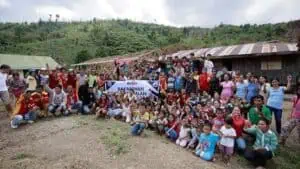
If you want to understand the cultural significance of Bayanihan, look beyond the image of people carrying a bahay kubo.
The deeper significance is this: Bayanihan teaches us that belonging creates responsibility.
When something matters to the bayan, ordinary people do not have to remain spectators. They can contribute. One person can move first. Others can add what they have. A burden that was too heavy for one person becomes something a community can carry together.
That is why Bayanihan is more than cooperation. It is a cultural idea about who we are to one another, what we owe to the common good, and what ordinary people can make happen when they choose to participate.
The culture becomes visible not when Filipinos say they believe in Bayanihan, but when shared responsibility becomes shared action.
Culture Is What We Make Normal
We often notice Bayanihan when something extraordinary happens.
A typhoon destroys homes. A family suddenly needs help. A community faces a crisis. People bring food, organize donations, clear roads, open their homes, and volunteer their time.
Those moments matter. They reveal something powerful about us.
But a culture cannot depend on disasters.
If Bayanihan appears only during emergencies, then we have preserved a heroic response without necessarily building a daily practice. We wait until the burden becomes enormous before remembering that we know how to carry things together.
Culture works differently.
Culture is what people learn to expect from one another. It is what becomes normal enough that nobody needs to give a speech before people know how to respond.
When a student notices that another student has been left behind and does something useful, something cultural is happening. When neighbors solve a shared problem before it becomes a crisis, something cultural is happening. When people at work stop defending their own small territories long enough to protect a shared result, something cultural is happening.
We cultivate what we practise.
So the question is not simply:
Do Filipinos still believe in Bayanihan?
A better question is:
What are we repeatedly doing that teaches the next generation how Bayanihan works?
Start With Bayan
To see why Bayanihan matters culturally, it helps to begin with bayan.
I use bayan, bayani, and bayanihan here as a practical map of ideas. I am not claiming that the historical development of the words can be reduced to a simple formula.
Bayan can point us toward community, people, town, or nation. What matters for this discussion is that the word moves our attention beyond the isolated individual.
There is an us.
There are people with whom we share spaces, histories, institutions, problems, opportunities, and consequences. We may not know everyone personally, but our lives still affect one another.
That is the first cultural move:
I am not alone here. I belong among other people.
Belonging sounds comforting, but it also creates a harder question.
If I belong to the bayan, what happens when the bayan carries a problem?
Is it always somebody else’s responsibility?
Or does belonging sometimes ask something of me?
This is where Bayanihan begins to move from identity into action.
Bayani Makes Contribution Visible
We usually translate bayani as hero.
That can make us think immediately of extraordinary individuals: people who sacrificed greatly, accomplished something historic, or became symbols of courage.
Those heroes matter.
But Bayanihan gives us room for another kind of heroism.
A person does not need to become famous before their contribution matters. Someone can step forward because something needs doing. A person can use a skill, give time, protect another person, solve a small problem, speak when silence is easier, or begin work that other people can join.
The act may be ordinary.
Its direction is not.
It moves beyond private convenience toward something that benefits others.
This is one reason the idea of Everyday Heroes belongs close to Bayanihan. Heroism need not always begin with the question, How can I do something extraordinary?
It can begin with:
What useful thing can I do here?
That is also closely connected with Move First. Somebody often has to make the first move before other people can see that movement is possible.
But the first mover does not have to become the permanent hero.
The deeper possibility is that others begin to move too.
Bayanihan Distributes Heroism
This is where Bayanihan becomes culturally powerful.
Imagine a heavy load that one person cannot carry.
The usual hero story asks:
Who is strong enough to carry it?
Bayanihan asks:
How can we carry it together?
That difference changes who gets to participate.
You do not have to be the strongest person. You do not have to have the most money. You do not have to hold the highest position. You do not have to solve the entire problem.
You need to find a useful part.
One person brings information. Another brings tools. Someone knows whom to call. Someone has a vehicle. Another person has two hours available. Someone prepares food while others work. Somebody notices the person nobody else has noticed.
No single contribution needs to look heroic on its own.
Together, the contributions can produce something remarkable.
This is one of the most important cultural promises inside Bayanihan:
Ordinary people do not have to wait for extraordinary people before something can change.
They can become participants.
And participation changes people from spectators into contributors.
From Belonging to the Common Good
This gives us a useful way to map the cultural movement of Bayanihan:
Belonging → Concern → Shared Responsibility → Contribution → Coordination → Common Good → Culture
It begins with belonging. I recognize that I am part of something larger than myself.
Belonging creates the possibility of concern. What happens to other people and to our shared spaces can matter to me.
Concern becomes shared responsibility when I stop assuming that every problem belongs entirely to someone else.
Responsibility becomes contribution when I identify something useful I can actually do.
Individual contributions require coordination if people are going to accomplish more than a collection of disconnected good deeds.
Coordination produces a common good when the result benefits the people whose lives, work, or community are affected.
And when that pattern happens repeatedly, it becomes culture.
People begin to expect participation.
Children see adults doing it. New employees see colleagues doing it. Students learn it from other students. Neighbors discover that raising a concern can lead to people actually working together.
Bayanihan stops being a story about Filipinos.
It becomes a way Filipinos learn to act.
Not Every Group Activity Is Bayanihan
This distinction matters.
People can act together without practising Bayanihan.
Ten people can cooperate to benefit themselves while hurting everyone else. A group can protect a member who has done something wrong. Friends can use pakikisama to discourage someone from speaking up. Employees can work together to hide mistakes from customers.
There is collective action in all of those situations.
But collective action alone is not enough.
Bayanihan needs direction.
The question is:
What good are we trying to make possible together?
The common good gives the action its moral direction.
That does not mean everyone must agree on everything. Bayanihan should not require silence, conformity, or obedience to the loudest person in the group.
In fact, sometimes the most useful contribution is disagreement.
Someone may have to say, “This is not working.”
Someone may have to question a familiar practice.
Someone may have to protect a person whom everybody else has ignored.
Someone may have to challenge a decision precisely because they care about what happens to the bayan.
Working together does not always mean thinking alike.
It means caring enough about a shared result to contribute what the situation requires.
Bayanihan Is People Empowerment
This is one of the strongest ideas in the original version of this article, and I would keep it.
Bayanihan is people empowerment.
Empowerment is often discussed as something a leader gives to people. Someone at the top delegates authority, provides resources, or gives permission.
Bayanihan reminds us that ordinary people already possess forms of power.
They can notice.
They can speak.
They can organize.
They can contribute.
They can invite others.
They can combine small resources.
They can create something that did not exist before.
Of course, there are limits. Citizens cannot simply take over responsibilities that belong to public institutions. Students cannot solve every problem in a school. Employees cannot repair every organizational system from below.
But recognizing limits should not become an excuse for learned helplessness.
Between “I must solve everything” and “There is nothing I can do” is an enormous territory called participation.
Bayanihan lives there.
This Is Why Bayanihan Matters to Good Citizenship
The cultural significance of Bayanihan becomes even clearer when we connect it with good citizenship.
A citizen is not merely somebody who lives within a country’s borders or avoids breaking laws. Citizenship also involves participating in shared life.
There are public spaces to protect. Institutions to improve. Information to examine before sharing. People whose rights matter. Community problems that require cooperation. Leaders who must be supported when they serve well and held accountable when they do not.
Bayanihan provides a Filipino language for that participation.
The citizen asks:
What is happening to our community?
What properly belongs to government or another institution?
What part can citizens contribute?
Who needs to be involved?
What would make the situation better for the common good?
This avoids two extremes.
One extreme says, “Government should do everything. I am only a taxpayer.”
The other says, “People should simply help each other, so institutions do not need to do their jobs.”
Neither is enough.
Citizenship requires both participation and accountability.
That relationship deserves a deeper discussion in The Role of Bayanihan in Our Life and Good Citizenship.
Teachers Can Make Bayanihan More Than a Definition
This is particularly important in school.
Students can easily memorize:
Bayanihan means helping one another.
They can write it on a quiz, draw a bahay kubo, color the people carrying it, and move to the next lesson.
They may learn the word without developing the practice.
A richer lesson asks students to investigate the behavior.
Present a situation.
A new student is repeatedly excluded from group activities. A class project has fallen almost entirely on two people. A shared area of the school keeps becoming dirty. Younger students are struggling with a subject older students understand well. False information about a classmate is spreading in a group chat.
Then ask:
What is the shared concern here?
Who is carrying the burden?
Who else is affected by what happens?
What could different people contribute?
What should not be taken over from someone else?
What would tell us that the situation actually improved?
Now Bayanihan is no longer a word to memorize.
It becomes a way of reading a situation.
Students begin learning that values are not labels for good people. Values help us decide what to do in moments that matter.
That is the larger idea behind the Filipino Values collection: what we believe must eventually become visible in what we do.
Bayanihan Has a Shadow Too
Every cultural strength can be practised badly.
Bayanihan is no exception.
Helping can become rescuing. One competent person can end up doing everything because others have learned that somebody will save them.
Cooperation can become conformity. People may avoid disagreement because they mistake harmony for unity.
Shared responsibility can become unclear responsibility. Everybody is supposedly responsible, so nobody knows who must actually finish the work.
Volunteerism can also become a convenient substitute for fixing systems. People repeatedly compensate for the same avoidable failure while the cause remains untouched.
We should not protect Bayanihan by refusing to examine these shadows.
We strengthen it by becoming more precise about what useful helping looks like.
Help People offers an important principle here: help should help. It should increase the possibility of useful movement rather than merely make the helper feel generous.
Sometimes Bayanihan means carrying a part of the load.
Sometimes it means helping another person become capable of carrying their part.
And sometimes it means asking why the same unnecessary load keeps appearing in the first place.
Culture Is Built Before the Crisis
Imagine two communities.
In the first, people rarely interact until something goes wrong. Then everybody is expected suddenly to cooperate, trust one another, share information, and organize.
In the second, people already practise small forms of participation. They know each other. They solve manageable problems together. They know who has which skills. They have learned how to ask for help and how to offer it without taking over.
When a crisis arrives, which community is more prepared for Bayanihan?
The second one has already built the muscle.
This is why everyday practices matter.
A class that learns how to distribute responsibility during an ordinary project is practising for bigger responsibilities later.
A neighborhood that solves a small shared concern is learning how to coordinate before an emergency.
A workplace that makes it normal to ask for help early is better prepared when the load suddenly becomes heavy.
Culture is built in repetition.
What we repeat when the stakes are small becomes more available when the stakes become large.
Try the Bayanihan Culture Map
Take one situation from your school, workplace, family, organization, or community.
Then walk it through this map:
Belonging
Who is the bayan in this situation? Who shares the consequences?
Concern
What matters here? Who is affected?
Shared Responsibility
What should not be left to one person alone?
Contribution
What useful part can different people carry?
Coordination
How will the different contributions work together?
Common Good
Who should be better off because we acted?
Culture
What could we repeat so that this becomes easier next time?
Do not begin by asking people to become heroes.
Give them a real situation in which they can contribute.
Heroism may emerge from the contribution.
A Culture of Bayanihan Is Built One Useful Move at a Time
The cultural significance of Bayanihan does not lie in proving that Filipinos are naturally helpful.
Culture is not guaranteed by nationality.
It has to be practised.
Every generation decides what part of its inheritance it will merely remember and what part it will make real again.
We can leave Bayanihan inside paintings, textbooks, speeches, and stories about disasters.
Or we can teach people to notice shared loads.
We can make contribution normal.
We can show children that citizenship includes participation.
We can help teams move from not my job toward shared results.
We can make it easier for ordinary people to discover that they do not have to solve everything before they can make something better.
That is the cultural promise of Bayanihan.
You do not have to become the hero who carries the whole house.
Find the part you can carry.
Help someone else find theirs.
Then move together.
Continue Exploring Bayanihan
For the complete introduction to the value, begin with Bayanihan: The Culture That Turns Ordinary Filipinos Into Heroes.
To see the value in contemporary situations, continue with Modern Examples of Bayanihan and Examples of Bayanihan.
To examine the Filipino values that help produce the Bayanihan spirit, read Values That Promote the Bayanihan Spirit.
To connect Bayanihan with participation, nation-building, and civic life, continue with The Role of Bayanihan in Our Life and Good Citizenship.
And if you want to move immediately from understanding to action, explore 10 Practical Steps to Do Bayanihan Anywhere in the Philippines and Ways to Promote Bayanihan.
How to Cite or Quote This Article
You are welcome to quote or cite this article in research papers, reports, presentations, learning materials, and other educational work.
This article was originally published on December 5, 2021, and substantially updated on August 18, 2026. The original publication date is preserved to show the history of the article, while the updated date identifies the version currently available on this page.
This article presents my practical interpretation of the cultural significance of Bayanihan. It should be used alongside scholarly and primary sources when writing academic work about Philippine culture, history, sociology, anthropology, citizenship, or related subjects.
APA 7th Edition
Menguin, J. (2026, August 18). The cultural significance of Bayanihan: How shared responsibility becomes culture (Original work published December 5, 2021). Jef Menguin. https://jefmenguin.com/cultural-significance-of-bayanihan/
For a paraphrase or general reference:
(Menguin, 2026)
For a direct quotation from a section without page numbers:
(Menguin, 2026, “Bayanihan Is People Empowerment” section, para. 3)
MLA 9th Edition
Menguin, Jef. “The Cultural Significance of Bayanihan: How Shared Responsibility Becomes Culture.” Jef Menguin, originally published 5 Dec. 2021, updated 18 Aug. 2026, https://jefmenguin.com/cultural-significance-of-bayanihan/.
Chicago Style
Menguin, Jef. “The Cultural Significance of Bayanihan: How Shared Responsibility Becomes Culture.” Jef Menguin. Originally published December 5, 2021. Last modified August 18, 2026. https://jefmenguin.com/cultural-significance-of-bayanihan/.
A Note for Researchers
When citing this page, August 18, 2026 identifies the substantially revised version, while December 5, 2021 identifies the original publication.
The article uses bayan, bayani, and bayanihan as a practical conceptual map for examining belonging, contribution, shared responsibility, and the common good. It does not claim that this map is a complete linguistic or historical account of the origin of the words.
Filipino communities also differ in how cultural values are understood and practised. Use the interpretations here as one practical framework for examining Bayanihan rather than as a claim that every Filipino understands or expresses the value in exactly the same way.


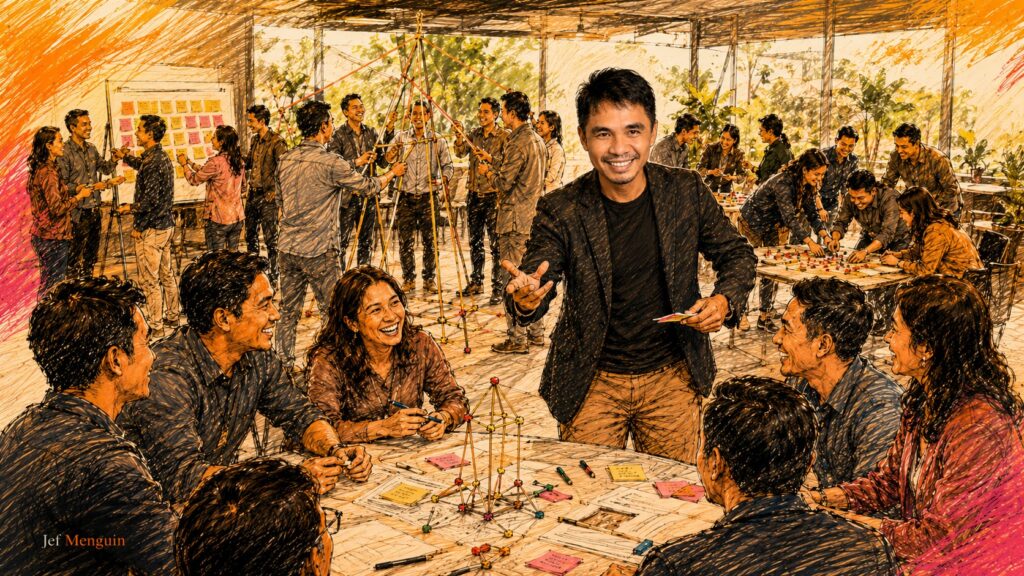
If you want Filipino values to show up as real behavior at work…
Let’s turn it into a culture shift experience.
→ Shift Experiences
