I postponed writing a book for almost twenty years because I did not think I was expert enough. When writing became necessary, I finished one in fourteen days—and discovered that writing was not merely proof of expertise. It was one of the ways expertise developed.
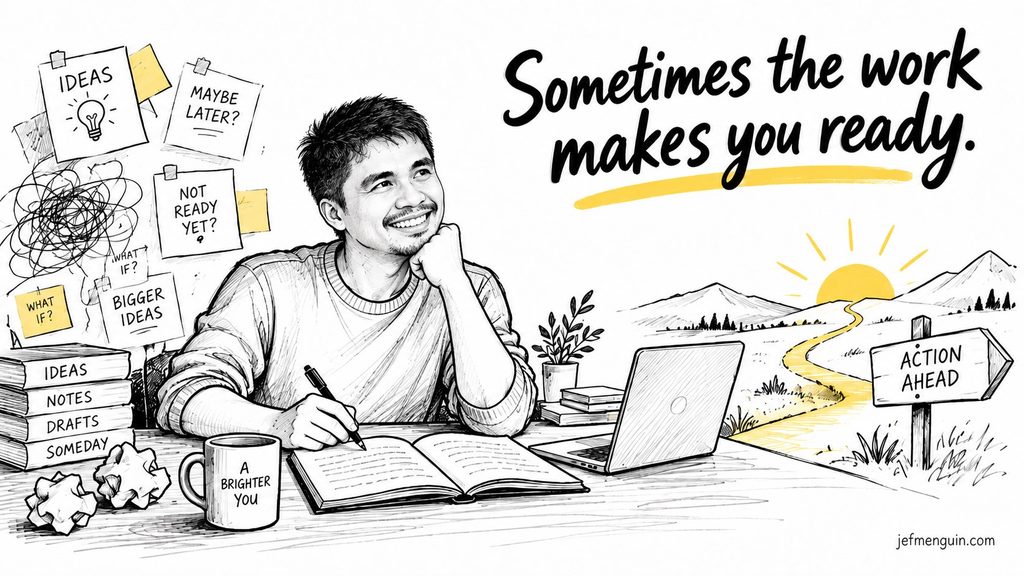
Your delay may have a reason
When was the last time you postponed something you genuinely wanted to do?
Perhaps you wanted to write a book, apply for an opportunity, begin a business, improve your health, or have an important conversation. You did not decide that it no longer mattered. In fact, you may have thought about it often. You imagined what could happen once you began, but the beginning kept moving to another day.
After several months, you may have wondered why something important received less attention than messages, errands, meetings, and small tasks you could barely remember afterward.
After several years, the question may have become more painful: Why have I still not done it?
It is easy to answer that question with an accusation. You may call yourself lazy, undisciplined, distracted, or inconsistent. Other people may use the same words because they can see the unfinished work but cannot see what happens inside you whenever you approach it.
But delay is not always evidence that you do not care. Sometimes the work remains postponed because it matters enough to expose something you would rather not face.
Six emails and a missed flight
I once had a six o’clock evening flight from Cebu. I had conducted a leadership seminar the day before, so I had the entire morning and much of the day available to work before returning to Manila.
I thought I had plenty of time.
The airport was usually about twenty-five to thirty minutes from the hotel where I was staying. Because the trip appeared short, I kept working. I told myself that I would leave after finishing a few things, and those few things became six emails.
The emails were not meaningless. They were work that needed attention, and completing them made me feel productive. Yet I could have answered them at the airport. What I could not do later was recover the time required to reach my flight.
Traffic took longer than thirty minutes. When I arrived, Cebu Pacific would no longer allow me to board. I looked at the clock and saw that several minutes remained before departure, but the decision had already been made.
Part of me wanted to blame the traffic or the airline’s boarding rules. Somewhere behind those thoughts, however, I knew that I had also made a choice. I had treated the six emails as though they had to be completed in the hotel, even when the flight was the work that mattered most at that hour.
That experience did not prove that answering emails is procrastination. It showed me that postponement does not always look like idleness. It may look like continuing to work on something legitimate while delaying the move the moment requires.
We sometimes remain busy so we do not have to stop, choose, and move.
The book I postponed for twenty years
The missed flight cost me a seat on an airplane. Another delay cost me much more time.
For almost twenty years, I wanted to write a book.
The desire did not disappear. I carried ideas, imagined titles, and thought about what I might say. Writing a book was not a casual wish. It remained one of the things I believed I should eventually do.
Yet I continued to postpone it.
One reason was that I did not consider myself expert enough. I thought I needed to know more, become more established, and develop ideas worthy of a book. I wanted the work to prove that I was good, but I did not want to begin until I already felt good enough to produce it.
That belief created a cycle I could not escape. I waited to become the person who could write the book, while avoiding the work that could help me become that person.
Then a time came when the book became necessary. I needed it, and waiting was no longer useful. I began writing.
The book that I had postponed for almost twenty years took fourteen days to write.
Those fourteen days did not mean that writing was effortless or that the previous years contributed nothing. I had accumulated stories, observations, questions, and experiences during those years. But I also saw that time alone had not written the book. Thinking about writing had not organised those ideas. Wanting to become an author had not produced the pages.
Writing did something waiting could not do.
As I wrote, I processed my thinking. Ideas that had remained separate began connecting. I saw gaps I had not noticed before. I discovered what I understood, what I only assumed I understood, and what still required examination.
The work did not simply display my expertise.
The work developed it.
The real enemy
When we postpone important work, we often treat ourselves as the problem. We believe the enemy is laziness, weak discipline, or lack of ambition. Then we attempt to defeat ourselves with shame, pressure, and promises that the next attempt will be different.
But people postpone for understandable reasons.
Beginning may expose the quality of your work. It may show that the idea is less complete than it appeared inside your mind. You may receive questions you cannot answer or discover that your first attempt looks like the work of a beginner.
Beginning may also threaten an identity you have worked hard to build. If people know you as capable, it can feel safer to remain excellent at familiar work than to become visibly inexperienced at something new.
The unfinished book allows you to imagine that you could write a good one. The finished first draft allows you to see how much you still need to learn.
The real enemy is not the fact that you feel uncertain. The real enemy is the belief that uncertainty must disappear before the work can begin.
We wait to become ready, credible, or good enough before doing the work that could help us become ready, credible, and good enough.
That belief turns preparation into a gate. You tell yourself that once you have read enough, learned enough, or gained enough recognition, you will finally enter the work.
But some abilities cannot be completed in preparation. They develop through action.
Write to become an expert
For years, I thought I needed to become an expert before writing a book. Writing the book showed me the opposite.
You do not write only because you are already an expert. Writing is one of the ways you become one.
The same shift applies to many things we postpone.
You do not speak only because you are already confident. Speaking is one way confidence develops.
You do not lead only after you have mastered every situation. Leadership develops as you make decisions, accept responsibility, listen, adjust, and try again.
You do not create only after every idea is clear. Creating gives your thinking a form you can examine and improve.
You do not begin because you have removed every doubt. Beginning helps you discover which doubts deserve attention and which ones only needed experience.
This does not mean preparation is unnecessary. A writer still needs to read, observe, think, and revise. A leader needs knowledge, judgment, and respect for the consequences of decisions. A professional must recognise where expertise, consent, and proper authority are essential.
The shift is not from preparation to carelessness. It is from treating preparation as a permanent substitute for practice.
Ask what you expect to become or possess
Choose one important work you have continued to postpone. Then complete this sentence:
Before I begin, I believe I must first become or possess __________.
You may believe you need more confidence, more credibility, more money, more time, a complete method, a larger audience, or permission from someone whose approval is not actually required.
Examine it your answer.
Is this something the work truly requires before you begin, or is it something the work itself may help you develop?
A person who wants to write may genuinely need time and a subject. But she may not need to feel like an author before producing the first chapter.
A person who wants to facilitate workshops may need sufficient knowledge and concern for participants. But he does not need to know how to handle every possible situation before practising with a small group.
A manager who wants to have a difficult conversation may need facts and the right setting. She may not need to predict every response before requesting the meeting.
The question is not, “Can I complete everything now?”
The question is, “What can only be learned after I enter the work?”
Find the work that creates the quality you are waiting for
Once you recognise what you have been waiting to possess, identify the practice that develops it.
When you say, “I am not good enough to write,” the answer is not to convince yourself that you are secretly excellent. The answer is to write something small enough to finish, read it honestly, and revise it.
When you say, “I am not confident enough to speak,” the answer is not to wait for a fearless personality to appear. Prepare a short message, speak to a small audience, review what happened, and speak again.
When you say, “I do not know enough to offer this service,” separate what you truly need to learn from what can be discovered only by helping a real person. Study what safety and competence require, then create a limited version that allows you to learn without promising more than you can deliver.
This is the important distinction: some gaps require preparation before action. Other gaps close only because of action.
Do not ask the work to prove that you were already good enough.
Allow the work to help you grow good enough for the next version.
Reduce the promise, not the reality
Often the first move appears to carry the weight of the whole dream.
The first chapter feels responsible for the entire book. The first video feels as though it must establish the speaker’s reputation. The first offer seems required to prove the future of the business.
That is too much responsibility for one beginning.
Reduce the promise of the first move. It does not need to prove that the entire project will succeed. It needs to produce the material, response, or lesson required for the next move.
However, do not reduce the move until it becomes pretend work. Choosing fonts for the manuscript is not writing. Creating another list of possible clients is not speaking with one. Rearranging a presentation is not testing whether people understand the central idea.
A useful first move is small enough to complete but real enough to create evidence.
That may mean writing five hundred words and allowing one trusted reader to respond. It may mean inviting three people to a short practice session. It may mean sending one proposal instead of developing an entire marketing campaign.
The move is limited, but reality can answer it.
Make one move before today ends
Think again about the work you have postponed. Then write four short paragraphs for yourself.
In the first, name why the work matters. Explain the person, contribution, promise, or possibility involved. This reminds you that the goal is not to prove your discipline. It is to give something important a chance to exist.
In the second, name what you thought you needed before beginning. Be specific. “I thought I needed to become more credible” is more useful than “I was afraid.”
In the third, identify how doing the work could help develop the quality you were waiting for. Could writing clarify your ideas? Could one conversation improve your understanding of the customer? Could practice create the confidence you expected to receive first?
In the fourth, name one honest move you can finish before today ends. Decide when and where you will do it.
The first win is not completing the entire dream. The first win is entering the practice that can begin changing you.
Practise before another year becomes twenty
A delay can last because nothing dramatic forces it to end. Each day, postponing the book appeared harmless. I could always write next month or next year. Twenty years were not lost in one decision. They passed through many small decisions that all seemed temporary.
That is why important work needs a practice, not merely an intention.
Set a time when the work will begin. Make the first version limited enough to finish. Let someone or something outside your thoughts respond. Then use what you learn to make the next move.
When resistance returns, do not immediately accuse yourself. Ask what standard, identity, or uncertainty you have once again placed before the work. Then ask whether the work itself is how that gap will be closed.
You may not be postponing because you do not care.
You may be postponing because you care about how the work will reflect on you. You want the book, business, conversation, or contribution to prove that you are ready.
But meaningful work is not only proof of who you have already become.
It is also practice for the person you are becoming.
Do not wait twenty years for evidence that only the work can give you.
Move First, and let the work begin teaching you.
Continue with Move First
Begin Before You Feel Ready
Readiness does not always arrive before action. Learn how to begin responsibly while uncertainty, discomfort, and doubt are still present.
Make the First Move Small Enough
Reduce the weight carried by the first move without turning it into another form of preparation that avoids reality.
Action Creates Confidence
Discover how experience, completed attempts, and promises kept can build the confidence you have been waiting to feel.
About Jef Menguin
Jef Menguin helps leaders make what matters happen. Move First, one of his signature motivational talks, challenges people to stop waiting for perfect readiness and make the next meaningful move. His other messages include Everyday Courage and Create Your Stage.