On Friday afternoon, Carlo’s manager called him into the office.
Carlo had been expecting bad news. A customer order had been delayed, and although the problem did not begin with him, he had spent most of the morning helping the team fix it. He entered the room ready to explain what happened.
His manager smiled.
“We have decided to make you the new supervisor.”
For a moment, Carlo did not know what to say. He had worked toward this promotion for years. He arrived early, stayed when the work was unfinished, and learned almost every part of the operation. When someone needed help, people looked for him.
Now the company had noticed.
His manager shook his hand, congratulated him, and said, “You know the work better than anyone. I’m sure you can handle the team.”
Carlo left the office carrying a new title and one clear desire: he would prove that the company had made the right decision.
The following Monday, he arrived earlier than usual. His former teammates greeted him with jokes.
“Boss na namin si Carlo.”
“Libre naman diyan.”
He laughed with them because he did not want the promotion to change anything. These were the same people who had shared lunch with him, covered his shift, and listened when work became difficult. He wanted them to know he was still the same person.
By ten o’clock, however, the work had begun to change.
One employee arrived late and quietly took his place without explaining. Another asked Carlo to approve an unfinished report because the deadline was near. A third ignored an instruction and followed the old process instead.
Carlo noticed everything. He corrected nothing.
He told himself he would speak to them later. He did not want to embarrass anyone. He did not want them to think the promotion had gone to his head. Most of all, he did not want his former teammates to stop treating him as one of them.
So he did what had made him successful before.
He worked harder.
He completed the unfinished report. He corrected the errors. He followed up on the delayed order. When someone struggled with a task, he took it back and finished it himself.
At seven that evening, Carlo was still at his desk. His team had gone home.
He looked at everything he had completed and felt two things at once. He was proud that the work had been saved. He was also beginning to wonder how long he could continue saving it.
This is the problem many companies try to solve through supervisory training. But before we decide what topics a new supervisor must learn, we must understand the shift the person has been asked to make.
Carlo had been promoted on Friday.
No one had taught him how to supervise by Monday.
The Title Changed Before the Person Did
A promotion changes the position quickly. The person often changes more slowly.
On Friday, Carlo was responsible for his work. On Monday, he became responsible for work completed through other people. His success was no longer measured only by what he could personally produce. He now had to create the conditions that helped other people produce good work.
That is a different job.
The skills that made Carlo promotable did not disappear. His technical knowledge still mattered. His discipline, reliability, and willingness to help remained valuable.
But those strengths could not carry the whole role.
Carlo knew how to complete the report. He had not yet learned how to hold someone accountable for completing it. He knew how to fix an error. He had not yet learned how to give feedback without attacking the person. He knew how to follow instructions. He had not yet learned how to set expectations that others could follow.
The title gave him authority.
It did not automatically give him the judgment, language, confidence, and habits required to use that authority well.
The Old Way of Winning Becomes the New Trap
Good employees often learn that effort solves problems.
When the deadline is near, work faster. When someone is absent, carry more. When the customer complains, fix the issue. When the team is struggling, step in.
This pattern can make a person dependable. It can also make that person visible to management. The one who repeatedly saves the work begins to look like the natural choice for promotion.
Then the promotion comes, and the same pattern becomes a trap.
The new supervisor continues rescuing the work because rescuing is familiar. It creates an immediate result. The task gets completed, the customer receives an answer, and the manager sees that the new supervisor is working hard.
But the team learns something too.
When the work becomes difficult, Carlo will take it.
When the deadline gets close, Carlo will finish it.
When someone fails to follow through, Carlo will absorb the consequence.
The supervisor becomes busier. The team becomes more dependent. Management sees a hardworking supervisor and may not notice that ownership is moving in the wrong direction.
The person has been promoted, but the old employee game continues.
Former Peers Make the Shift Harder
Several days after Carlo’s promotion, the employee who had arrived late came late again.
This time, the delay affected a handover. Another employee had to wait. Work that should have started at eight did not begin until almost nine.
Carlo felt the frustration rising in him. He had already spoken about punctuality with the whole group, although he had carefully avoided naming anyone.
Nothing changed.
He called the employee aside.
Before Carlo could begin, the employee smiled and said, “Pare, pasensya na. Alam mo naman ang traffic.”
Carlo knew about the traffic. He also knew this was the second time in one week. He wanted to explain the effect on the handover, agree on what had to change, and make the expectation clear.
Instead, he said, “Sige. Basta huwag na lang ulit.”
The conversation ended. The problem did not.
Carlo walked away disappointed with the employee and angry with himself. He knew what he should have said. But knowing the issue and leading through the issue were not the same.
This is one of the hardest transitions for a new supervisor.
Yesterday, you listened to complaints about management. Today, you must explain a management decision.
Yesterday, you ignored a small mistake because it was none of your business. Today, allowing that mistake may damage the whole team.
Yesterday, keeping the friendship comfortable felt generous. Today, avoiding the conversation may be unfair to everyone who arrives on time and does the work.
The new supervisor does not need to stop caring about former peers. The person must learn a more demanding form of care.
Clear expectations are care.
Fair correction is care.
Honest feedback is care.
Allowing one person to repeatedly pass the cost of poor performance to everyone else is not kindness. It is avoidance disguised as kindness.
Promotion Creates Authority, Not Confidence
Many new supervisors hesitate because they believe confidence should arrive with the title.
It rarely does.
The new supervisor may be afraid of sounding arrogant. The person may worry about making the wrong decision, losing friendships, or being exposed as unready. Even a supervisor who appears confident may be quietly asking:
What if they do not listen to me?
What if I correct someone and make the situation worse?
What if my manager realizes I do not know what I am doing?
What if the team liked me before but no longer trusts me now?
These fears do not disappear because Human Resources changes the job title.
Confidence grows when supervisors understand the role, practise difficult moves, receive useful feedback, and see that they can handle real situations without becoming controlling, distant, or cruel.
They need more than encouragement.
“You can do it” may help for a moment. But when a former peer ignores an instruction, when two employees blame each other, or when the team misses an important target, the supervisor needs a move.
How do I begin the conversation?
How do I explain the standard?
How do I listen without losing the issue?
How do I agree on the next step?
How do I follow through without turning into a police officer?
These questions are not signs of weakness. They are signs that the real work of supervision has begun.
New Supervisors Must Learn a Different Way to Win
The employee wins by completing good work.
The supervisor wins when the team can complete good work consistently.
That shift sounds simple when written in one sentence. In practice, it changes almost everything.
The new supervisor must move from doing to enabling. This does not mean refusing to help. It means helping in ways that make people more capable instead of more dependent.
The new supervisor must move from being liked to being trusted. Being liked feels good, but trust requires fairness, honesty, consistency, and the courage to say what needs to be said.
The new supervisor must move from receiving instructions to creating clarity. Employees need to understand the expected result, the standard, the owner, the deadline, and the next move.
The new supervisor must move from fixing every problem to building ownership. Some problems require the supervisor’s decision. Others require the supervisor to ask better questions and help the employee think.
The new supervisor must also move from personal output to team rhythm. Follow-through cannot depend on memory, repeated reminders, or the supervisor chasing everyone. Commitments must become visible. Huddles must move the work. Feedback must happen before small problems become expensive.
These are not advanced leadership theories.
They are daily supervisory plays.
Companies Must Stop Treating Promotion as Preparation
When a newly promoted supervisor struggles, the easiest conclusion is that the company chose the wrong person.
Sometimes that is true. Not everyone wants the role, and not everyone is ready for it.
But companies must also examine the start they gave the person.
Did anyone explain how success would now be measured?
Did the new supervisor learn how to lead former peers?
Did the manager clarify what the supervisor could decide?
Did the person practise setting expectations, delegating work, giving feedback, and handling missed commitments?
Did anyone check what happened during the first difficult weeks?
Or did the company announce the promotion, provide a new title, and hope experience would do the teaching?
Experience will teach something. But experience without guidance can teach the wrong lesson.
A supervisor who is punished for every team mistake may learn to control everything.
A supervisor who receives no support during conflict may learn to avoid difficult conversations.
A supervisor who is praised only for saving missed deadlines may learn to carry everyone’s work.
A supervisor who is told to “show leadership” without being shown what leadership looks like may copy the loudest manager in the building.
Leaving people to figure it out is not development.
It is a gamble.
Give New Supervisors a Real Start
A real start does not require teaching every leadership topic in one program.
New supervisors need to understand the role they are entering. They need to see why the old ways of winning are no longer enough. Then they need practical plays for the moments they are most likely to face.
How do I step into the role without pretending to be someone else?
How do I lead former peers fairly?
How do I give clear direction?
How do I use authority without becoming controlling?
How do I handle a missed commitment?
How do I help people take ownership?
The answers cannot remain inside a slide deck. Supervisors must practise them, use them at work, reflect on what happened, and try again.
That is how the title begins to become a role.
That is how authority begins to become leadership.
That is how a hardworking employee begins to become a supervisor who helps other people win.
The Promotion Was Only the Beginning
A few weeks after his promotion, Carlo faced another unfinished report.
His first instinct was to take it and complete it himself. He could finish it faster. He could avoid another delay. He could once again become the person who saved the work.
This time, he stopped.
He sat beside the employee and asked what had prevented the report from being completed. They reviewed the expected result, identified the missing information, and agreed on the next action and checkpoint.
Carlo did not abandon the employee.
He also did not take the work back.
The report was completed later that afternoon. It was not perfect, but the employee had finished it, understood the gaps, and knew what to do differently next time.
Carlo left the office without carrying the report home.
The change looked small. No one announced it. No certificate appeared. But something important had moved.
The employee became more capable.
The supervisor carried less.
The team gained a little more ownership.
That is what promotion alone cannot create.
Promotion can give someone a new title, a higher salary, and a seat closer to management. It can open the door.
But someone still has to help the new supervisor cross it.
When companies are ready to give newly promoted supervisors more than a title, they can begin by examining what their supervisory training must change—not only what topics it should cover.
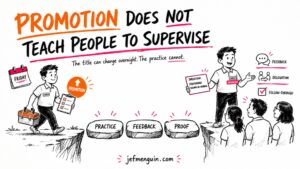
Because promotion does not teach people to supervise.
Practice does. Guidance does. Reflection does. Real workplace experience, supported by useful plays, does.
The promotion is only the announcement.
The development must come next.
