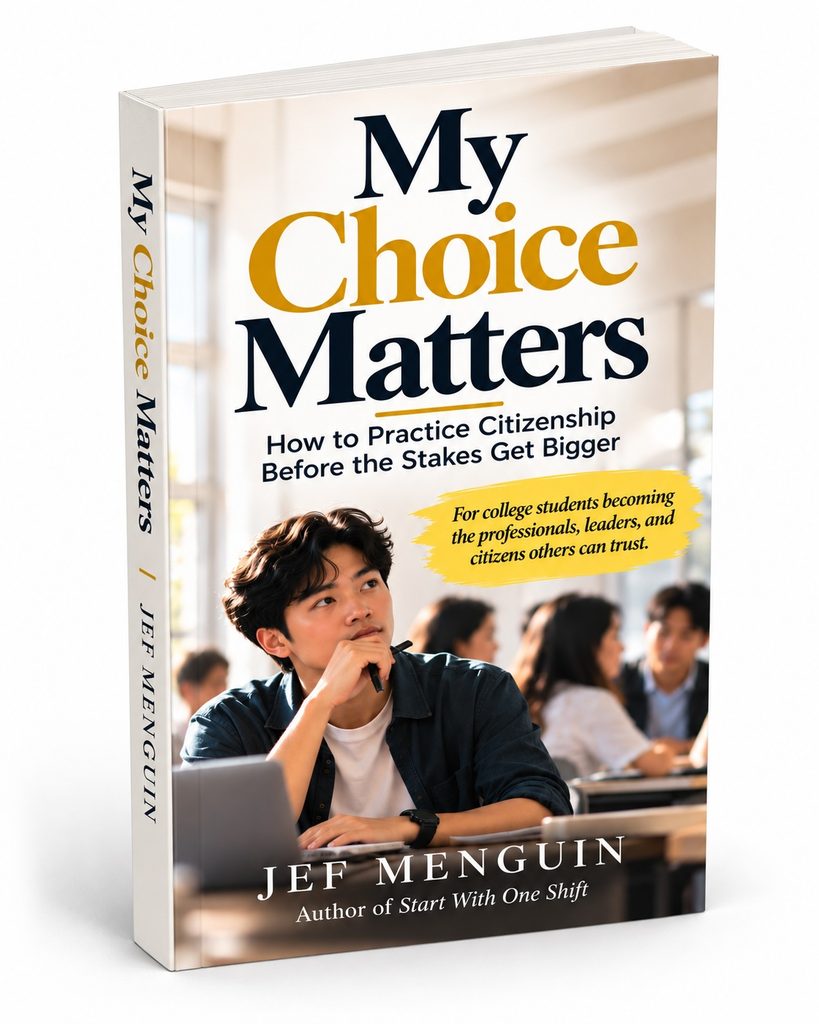
My Choice Matters
The Everyday Practice of Good Citizenship
Citizenship is often discussed in big moments—elections, national issues, laws, public controversies, and questions about government. But most of the choices that shape a community do not happen on a stage. They happen in ordinary places, through ordinary decisions, made by people who may never think of themselves as doing anything important.
My Choice Matters begins there.
It is a book about the everyday practice of good citizenship: the choices we make when no one is watching, when there is no applause, and when the consequences seem small. How we treat other people. How we use shared spaces. How we respond when something is unfair. Whether we follow a rule only because someone might catch us, or because we understand what that rule is trying to protect. Whether we wait for someone else to act, or decide that we also have a part to play.
The book makes a simple claim: our choices matter because citizenship is not something we merely have. It is something we practice.
A good citizen is not formed only by knowing rights, memorizing values, or understanding how institutions work. Citizenship becomes visible in behavior. It appears in the way we respect others, take responsibility, contribute, speak up, cooperate, care for what belongs to everyone, and make decisions with consequences beyond ourselves.
That can happen in a classroom, at work, on the road, in a neighborhood, online, or at home. The situation may look small, but the habit being formed is not. Every time we choose honesty over convenience, responsibility over indifference, contribution over complaint, or consideration over selfishness, we strengthen the kind of person we are becoming.
The opposite is also true. When we repeatedly tell ourselves that our action does not matter, that someone else will take care of it, or that one small shortcut will make no difference, those choices also accumulate. Communities are shaped not only by the values people say they believe in, but by what people repeatedly choose to do.
My Choice Matters does not ask the reader to become perfect. It asks the reader to become more aware. What is happening here? Who may be affected by what I do next? What responsibility belongs to me? What kind of choice would help rather than harm? These questions make citizenship practical because they move it from abstract ideals into real moments.
This is especially important for young people. Students do not need to wait until adulthood before becoming citizens who contribute. They are already making choices that affect classmates, teachers, families, communities, and the spaces they share with others. Every ordinary decision becomes a place where character, responsibility, and citizenship can be practiced.
The point of the book is not to tell readers what to think about every issue. It is to help them recognize that their everyday decisions have weight. A better community is not built only through grand programs or heroic acts. It is also built through millions of small choices made with greater awareness, responsibility, courage, and care.
That is why one of the most useful questions we can carry is also one of the simplest:
What kind of citizen am I becoming through the choices I make today?
Your choice may seem small. But it becomes part of a habit, a relationship, a culture, and eventually a community.
My choice matters. So does yours.