You have already done the hard thinking.
You know what you want to make happen. You have made the goal specific enough to understand, measurable enough to follow, realistic enough to pursue, relevant enough to deserve your effort, and time-bound enough to create movement. You have also decided that you will evaluate what happens and readjust when the evidence gives you a reason.
That is where SMARTER Goal Setting leaves you.
And for a moment, it feels good.
The goal is clear. You open a spreadsheet or notebook and begin planning. You list the activities. You assign dates. Perhaps you divide the work into weeks, create milestones, estimate costs, and decide who will do what. Slowly, the blank page fills up. The uncertainty that bothered you begins to disappear because now you have a plan.
Then the work begins.
A customer does not respond the way you expected. Something you thought would take two days needs two weeks. The campaign gets attention but not from the people you hoped to reach. Someone leaves the team. A new opportunity appears. Or you simply discover, after finally doing the work, that one of your original assumptions was wrong.
That moment can be frustrating because the plan was supposed to remove uncertainty.
Instead, reality has returned it.
This is where SMARTER planning becomes useful.
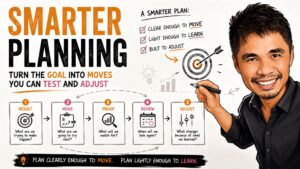
Plan clearly enough to move. Plan lightly enough to learn.
SMARTER Planning Continues Where Goal Setting Ends
A goal and a plan do different jobs.
Your goal tells you what you are trying to make happen. Your plan contains your current choices about how you might make it happen. Once you begin acting, a third thing enters the picture: reality gives you information that was not available when you made either one.
This is why I do not think SMARTER planning means making a more detailed plan. More detail can be useful, but detail does not make uncertainty disappear.
SMARTER planning means building learning into the way you move.
Instead of treating planning as:
Goal → Plan → Execute → Finish
you begin to work in another rhythm:
Goal → Move → Proof → Review → Adjust → Next Move
You still plan. You still think ahead. You still make commitments.
But you stop asking the plan to predict everything the work will teach you.
The Goal Can Stay While the Plan Changes
Suppose the SMARTER goal you carried over from the previous page is:
Increase Product A sales by 10 percent by November 30.
That is the result you want.
Now you have choices. You might contact existing customers, run webinars, improve the sales conversation, create a referral campaign, enter another market, publish useful content, change the offer, or combine several of these moves.
You decide to run webinars.
The plan looks sensible. You schedule four sessions, prepare promotional materials, set attendance targets, and create follow-up messages designed to turn interested participants into sales conversations.
Then you run the first two.
People attend. Some even stay until the end. The numbers look respectable, so you could easily report that the webinars are working.
Except almost nobody asks to talk with you afterward.
Now you feel the pull that many plans create. You have already invested time. The next two webinars are on the calendar. The slides are finished. The promotional posts have been drafted. Continuing feels easier than questioning the move.
But what are you committed to?
The webinars?
Or the sales goal?
That distinction changes the conversation.
Perhaps the webinars attracted the wrong people. Perhaps the topic was useful but too far from the problem your product solves. Perhaps the invitation to take another step was weak. Or perhaps webinars simply are not the strongest move for this particular goal.
The goal may survive. The plan does not have to.
That is not inconsistency. It is learning.
Choose Before You Plan
There is another trap worth avoiding. Sometimes we start planning before we have really chosen.
The result is familiar. Every department has an initiative. Every good idea becomes a project. Every project receives a deadline. Nobody wants to remove anything because each item can be defended as important.
The finished plan looks impressive.
The people looking at it feel tired.
This is why SMARTER planning must still begin with Choose What Matters. Before asking how you will do everything, decide what genuinely deserves to move.
Strategy matters here too. In Strategy First, Plan Second, I distinguish between choosing the game and organizing the work. Strategy says where you intend to play, how you hope to win, and what you are willing not to pursue. The plan turns those choices into actions, responsibilities, resources, and time.
If the strategic choices are weak, planning harder only organizes the confusion.
Sometimes smarter planning begins by deleting something.
Planning Feels Safer Than Moving
There is a reason detailed planning can become attractive when the stakes rise.
Planning lets us stay in a world where nothing has failed yet.
The idea still looks good on the slide. The forecast still works. The customer has not rejected the offer because the customer has not seen it. The manuscript has no critics because nobody has read it. The new process has no problems because nobody has tried using it under pressure.
We can keep improving the plan and feel as though we are reducing risk.
Sometimes we are.
Sometimes we are postponing the moment when reality gets a vote.
In my decision-making work, I use the idea Life Is Poker, Not Chess. Chess gives you a board where all the pieces are visible. Poker does not. You make decisions without knowing everything, and the quality of the decision cannot be judged only by whether the next card happened to favor you.
Planning often works more like poker.
You gather what you can. You think. You examine risk. You make the best choice you can with the information available.
Then you move.
And movement reveals things planning cannot.
This is where Move First becomes part of planning rather than the opposite of it. Moving first does not mean refusing to think. It means recognizing the point at which more thinking will not give you the information only action can provide.
Plan with what you know. Move to discover what you don’t.
Make the First Move Big Enough to Matter, Small Enough to Learn
Suppose you want to launch a new leadership program.
You could build the entire thing before anyone sees it. Create eight modules. Design the workbook. Produce videos. Finish the facilitator guide. Build the landing page. Prepare the campaign. Record promotional materials.
Months later, you finally place the finished product in front of a buyer.
And the buyer asks for something different.
That hurts.
Not only because the idea did not land, but because you already built so much around an assumption nobody had tested.
A SMARTER plan might begin differently. You could talk with ten potential buyers. Teach one important part of the program. Run a short pilot. Describe the idea publicly and listen carefully to the questions people ask. You might still eventually build the eight modules, workbook, videos, and campaign—but now those decisions grow from contact with the people the program is supposed to help.
The first move is not small because your ambition is small.
It is small because you want to learn before the cost of changing becomes unnecessarily high.
That is an important distinction.
You are not playing timidly.
You are buying information.
A Good Plan Tells You What to Notice
Once people begin planning, attention naturally goes toward activities.
Run the webinar. Call the customers. Finish the prototype. Publish the article. Conduct the meeting.
Those moves matter, but they create another danger: once the activity is completed, we feel progress has been made.
Sometimes it has.
Sometimes all we know is that the activity happened.
In my work on learning experiences, I use the idea of proof because trying something is not the same as changing something. A useful move should eventually leave evidence—a different behavior, a response, a decision, a result, a pattern beginning to change.
The same idea belongs in planning.
Before running the webinar, ask what you hope to learn from it. Attendance might matter, but perhaps the stronger proof is whether the right people attend, whether they recognize the problem, whether they ask questions that reveal urgency, and whether some want to continue the conversation afterward.
Now the webinar has two jobs.
It may help create the desired result.
And it may teach you whether your current way of pursuing that result deserves another round.
That is why Make Your Work Matter connects naturally to SMARTER planning. Activity can be counted. Movement has to be noticed.
A good plan does not only tell you what to do. It tells you what to notice.
Then Comes the Uncomfortable Part: Look
Evaluation sounds easy until the evidence challenges something you already like.
If the numbers are good, we enjoy reviewing them. If customers respond as expected, the meeting is pleasant. The plan appears wise, and so do the people who made it.
The harder review happens when the work says something we do not want to hear.
The product is not gaining traction.
The audience is not interested.
People are ignoring the new process.
A project everybody was excited about is consuming resources without producing much.
This is where SMARTER planning asks for more than measurement. It asks for honesty.
You have to be willing to ask:
What is actually happening?
Not: How can we explain why the plan should still work?
Not: Who failed to execute it properly?
Not even immediately: What should we change?
First, see.
A useful review creates enough distance between the plan and your ego that evidence is allowed to say something.
But Do Not Panic Every Time the Result Is Bad
There is another emotional swing that can happen.
The first attempt disappoints you, so now you want to change everything.
That is not SMARTER planning either.
One unsuccessful conversation does not invalidate a sales approach. One webinar with poor attendance does not prove the market is uninterested. A new workplace behavior may initially feel awkward precisely because it is new.
Some moves need repetitions before the pattern becomes clear.
This is why I use another distinction in decision-making: a good decision can produce a bad result, and a bad decision can occasionally produce a good one. One outcome is information, but it is not always enough information.
So ask a more patient question:
What does this result actually allow us to conclude?
Sometimes the answer is: very little. Run the play again.
Sometimes the evidence suggests changing one thing rather than abandoning everything.
And sometimes you have seen enough.
That is where courage changes shape. At first, courage meant beginning. Now it may mean admitting that the familiar move is not taking you where you want to go.
When that happens, Change Your Game becomes the natural next move.
Know What Must Be Planned Before You Act
There is an important boundary to all of this.
“Plan lightly enough to learn” does not mean casual planning.
Some choices are difficult to reverse. Some failures can hurt people, destroy trust, waste substantial resources, or create legal and operational consequences. Building a facility, migrating a critical system, making a major investment, or staging a large event may require significant planning before execution begins.
The question is not whether detailed planning is good or bad.
Ask:
What must we know before moving because getting it wrong would be costly—and what can we only learn by moving?
Where the cost of reversal is high, plan more deeply.
Where a move is inexpensive, reversible, and capable of producing valuable information, move sooner.
SMARTER planning is not less planning.
It is planning with respect for uncertainty.
I Have Seen My Own Plans Change
I can see this when I look at my own work.
In a strategic game plan I wrote in 2025, the moves were concrete. Public seminars. Weekly webinars. Audience targets. Conversion goals. There was value in that specificity because an ambition without an execution path remains an ambition.
At that point, those moves reflected what I could see.
Then I kept building.
As the work developed, I began organizing products in another way: product hubs, workshops, cohorts, scenarios, practical plays, named tools, proof, and systems for improving the products themselves. The opportunity looked different because I was no longer looking at it only from the planning table. I had been inside the work.
There is a temptation, when looking backward, to judge the earlier plan using everything you know now.
That is unfair.
The earlier plan could not know what the later work had not yet taught me.
And that may be the most important lesson SMARTER planning has given me.
A plan does not have to predict who you will become after doing the work.
It needs to help you begin becoming.
Use the SMARTER Planning Card
You can make this practical without building another complicated planning system.
Take one SMARTER goal and put it through five questions:
RESULT — What are we trying to make happen?
Keep the result visible. If you cannot answer this clearly, return to SMARTER Goal Setting.
MOVE — What are we going to try next?
Not every activity you could possibly do. Choose the next move that deserves action.
PROOF — What will we notice if this move is helping?
Decide what evidence you want before the activity begins. Otherwise, it is too easy to count completion as success.
REVIEW — When will we look again?
Use a date, a number of attempts, a milestone, or another meaningful trigger.
ADJUST — What changes because of what we learned?
Continue. Improve. Stop. Replace. Expand. Then choose the next move.
The sequence is simple:
Result → Move → Proof → Review → Adjust
But do not mistake the simplicity for rigidity. The card exists to keep the conversation alive.
Eventually, the Plan Has to Reach Tuesday Morning
There is one final test.
Look at your calendar.
You may have an inspiring goal for the year and a carefully considered plan for the quarter. But if Tuesday is filled completely by meetings, email, requests, emergencies, and other people’s priorities, your supposedly important goal still has not entered your life.
This is something I explored deeply in Own Your Time. A person can be busy all day and still keep postponing the work that matters most. The problem is not always time. Sometimes the calendar simply tells a different story from the one the strategy tells.
That gap matters.
So take your plan and bring it all the way down to today.
What is the result you are trying to move?
Given what you know now, what deserves to happen next?
And where, exactly, will that move happen?
Perhaps it is a customer conversation at 10 a.m. Perhaps you will put the first version in front of somebody before lunch. Perhaps you need thirty protected minutes to finish something that has remained almost done for three weeks.
Now the plan is no longer a document.
It has entered the day.
Let the Plan Learn
You do not need to know every move between here and the result.
You need enough clarity to avoid wandering. Enough preparation to avoid foolish risks. Enough courage to put your thinking in contact with reality. And enough humility to let reality teach you something.
Some days, the proof will tell you to keep going.
Some days, it will tell you to change the move.
And occasionally, it may force you to reconsider something you were certain about when you began.
That does not mean planning failed.
It means you are no longer planning with yesterday’s information.
So take the goal you have already chosen. Decide what deserves to move now. Name the proof you want to see. Make the move, then look carefully at what happens.
Plan clearly enough to move. Plan lightly enough to learn.
Plan with what you know.
Move to discover what you don’t.
Then use what you learn to make what matters happen today.


If your team is stuck in meetings, misalignment, or slow decisions…
Let’s design one shift they can use immediately.
→ Shift Experiences
