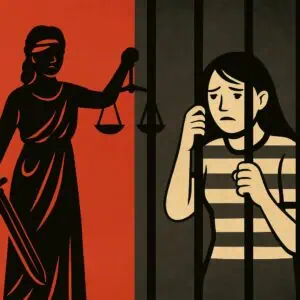
Justice is supposed to mean fairness, balance, and order. Yet in the Philippines—as in many parts of the world—justice often favors the powerful and punishes the powerless.
Recently, ABS-CBN reported the story of a woman who spent 23 years in prison for a crime that should have carried only a 30-day sentence. She killed her alleged rapist, was initially convicted of murder, but later her case was reduced to less serious physical injuries. By law, she should have been freed decades ago.
Instead, a technicality kept her behind bars.
For 23 years, she lived as a “person deprived of liberty”—not just of freedom, but of years of life, family, and dignity.
The Harshness of the System for the Poor
Her tragedy is not isolated. Hundreds of prisoners remain locked up even after serving their sentences—because of missing paperwork, absent lawyers, or families too poor to intervene.
The powerless are often crushed by the weight of the system. Every rule, every delay, every signature denied becomes another invisible chain.
The Scandalous Freedom of the Powerful
Now contrast this with what happens when the accused are not powerless but powerful.
- In the 2016 elections, promises were made to free politicians charged with plunder—and some were indeed freed.
- There are those with multiple convictions, even seven or more, who continue to live freely outside while ordinary citizens rot in jail for minor offenses.
- Worse, many who have looted public coffers or enabled the killing of thousands not only escape accountability but even rise again to power—winning elections, holding office, reshaping laws.
Here, the rules bend. Technicalities become shields instead of chains. Where the poor are forgotten, the powerful are forgiven.
This is not merely injustice. It is impunity.
Justice Delayed, Justice Denied
How do we measure the cost of 23 lost years for a woman who should have served only 30 days?
And how do we measure the cost to the Filipino people when billions are stolen, thousands are killed, and those responsible are rewarded with votes, power, and prestige?
The equation is cruel: the poor pay too much, the powerful pay nothing.
The Call of Magsaysay
Decades ago, President Ramon Magsaysay declared:
“Those who have less in life should have more in law.”
It was not just a slogan. It was a call to justice that protects the powerless first, not last.
Yet today, the opposite often holds true. Those who have less in life have less in law. And those who already have much—money, influence, machinery—are the ones most shielded by legal loopholes and political favors.
From Anger to Action
The story of the woman jailed for 23 years should enrage us. But the greater scandal is not hers alone—it is the wider system where the scale of justice tilts depending on who stands before it.
If we truly believe in Magsaysay’s vision, then we must:
- Reform prison release systems so no one overstays a sentence for lack of paperwork.
- Ensure equal application of the law—whether one is penniless or powerful.
- Demand accountability from leaders, judges, and voters alike.
The Real Test of Justice
The measure of a nation’s justice is not how harshly it punishes the weak but how firmly it restrains the powerful.
If a poor woman loses 23 years for a 30-day penalty while plunderers, killers, and cheats win elections, can we still call this justice?
The woman’s freedom is a relief. But our collective freedom will only come when Magsaysay’s words are no longer aspiration but reality—when those who have less in life truly have more in law.




If you want Filipino values to show up as real behavior at work…
Let’s turn it into a culture shift experience.
→ Shift Experiences
