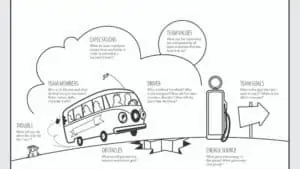
A team charter fixes the silent drift that makes meetings heavy, decisions slow, and “we’re not aligned” become the team’s favorite excuse. In this article, Jef Menguin shows how to use a team charter as a strategy conversation—not a form—so roles, rules, and “what winning looks like” become clear. Practice it and share it with your leadership team so you stop guessing, decide faster, and commit harder.
A few years ago, I worked with a small leadership team inside a growing organization. Smart people. Hard workers. Good intentions all around.
And yet, every meeting felt heavy.
They talked a lot, but decisions dragged. Projects moved, but never fast enough. When something failed, the post-mortem always sounded the same: “We weren’t aligned.”
What struck me wasn’t the lack of effort. It was the quiet confusion underneath it all.
Everyone thought they were doing the right thing. Everyone thought they were helping the team win. But they were playing different games, using different rules, aiming at different definitions of success.
That’s the moment when a team doesn’t need another meeting.
It needs a reset.
Why Teams Struggle Before They Fail
Most teams don’t break because of conflict. They break because of unspoken assumptions.
One person thinks speed matters most. Another believes quality must never be compromised. A third assumes the leader will decide when things get hard. A fourth is waiting to be consulted before acting.
No one says these things out loud. So everyone keeps guessing.
This is where a Team Charter matters—not as a document, but as a shared decision about how the team will play the game.
Because work is a game, whether we admit it or not.
There are goals. There are constraints. There are roles. And there is a real cost to playing badly.
A Team Charter Is Not a Form. It’s a Strategy Conversation.
When people hear “team charter,” they imagine a template to complete. Boxes to fill. Words to agree on politely.
That mindset misses the point.
A Team Charter is not about completing a canvas. It’s about making the invisible visible so the team can play to win.
The canvas simply gives structure to a conversation teams rarely slow down enough to have.
Let me show you what this looks like in practice.
A Real Team, A Real Reset
That leadership team I mentioned earlier decided to pause for half a day. No slides. No updates. Just one question to start:
“If we keep working the way we do now, will we actually win?”
That question changed the tone immediately.
We used the Team Charter Canvas not as a worksheet, but as a thinking tool. One section at a time. Honest discussion. Some tension. A few uncomfortable silences.
And that was a good sign.
Starting with Purpose: Why This Team Exists
The team began with purpose, and at first, the answers sounded safe.
“Support the organization.” “Deliver results.” “Help our departments succeed.”
None of those were wrong. They were just empty.
So we pushed further.
I asked them to finish one sentence together:
“This team exists to _____ so that _____.”
After debate and revision, they landed on something clearer and sharper:
“This team exists to make fast, aligned decisions so the organization doesn’t stall.”
You could feel the shift in the room.
Suddenly, speed and alignment weren’t preferences anymore. They were the reason the team existed.
That single sentence became a filter for everything else.
Defining the Destination: What Winning Looks Like
Next, we talked about where the team was going.
Not tasks. Not deliverables. Outcomes.
I asked them to imagine an outsider observing them six months from now.
“What would that person say this team does well?”
At first, the answers were vague. But eventually, they converged on something concrete:
- Decisions are made within one meeting.
- Trade-offs are stated clearly, not hidden.
- Once a decision is made, everyone supports it publicly.
This wasn’t a vision statement. It was a definition of winning.
And once winning was clear, behavior became easier to discuss.
Agreeing on How to Work Together When It Gets Hard
This is where the real work began.
The team talked about values before. Respect. Openness. Collaboration. None of those helped when pressure hit.
So instead, we talked about moments of stress.
What happens when deadlines collide? What happens when two leaders strongly disagree? What happens when speed and quality are in tension?
They turned those moments into explicit agreements.
- Disagreement happens in the room, not after.
- Silence does not mean agreement.
- If you disagree, you propose an alternative—no silent resistance.
These weren’t aspirational statements. They were rules of play.
People nodded not because the words sounded good, but because they recognized the pain those rules were meant to prevent.
Clarifying Roles: Who Carries What Weight
The next shift was subtle but powerful.
Instead of listing roles, we talked about ownership.
Who drives decisions? Who provides input? Who has veto power—and when?
In one case, the team realized they were involving everyone in everything. Decisions slowed because no one knew who was actually accountable.
They changed that.
From then on, every major discussion started with a simple clarification: “Who owns this decision?”
That one habit saved hours every week.
Naming the Non-Negotiables
Finally, the team named what they would protect no matter what.
Not many things. Just a few.
- We do not trade long-term trust for short-term speed.
- We do not surprise each other in public forums.
- We do not escalate without first talking directly.
These weren’t rules imposed from above. They were commitments made to each other.
That made all the difference.
The Real Shift the Team Made
The goal was never to finish the canvas.
The real shift was this:
From “We’ll figure it out as we go.”
To “We’ve agreed on how we play, especially when it’s hard.”
After that session, meetings changed. Not magically, not overnight—but noticeably.
People referenced the charter in conversations. They called out misalignment early. They made faster decisions with less emotional residue.
Not because they became better people.
But because they stopped guessing.
How to Use the Team Charter Canvas Well
If you use the canvas, use it this way:
- Slow down the conversation.
- Stay with the tension instead of smoothing it over.
- Translate ideas into observable behavior.
- Keep asking, “How does this help us play to win?”
Because alignment is not about agreement. It’s about shared understanding and shared commitment.
And a team that plays the same game, by the same rules, toward the same goal—that team doesn’t just work harder.
It wins more often.
Download: 90-Minute Team Charter Workshop







If your team is stuck in meetings, misalignment, or slow decisions…
Let’s design one shift they can use immediately.
→ Shift Experiences

Pingback: Team Building for Team Leaders: Success Guide