Explore the Leadership Training Programs
I designed these leadership programs around the real moments where leaders must decide, communicate, coach, align people, and move work forward.
The programs featured here are offered to organizations through Strategic Learning Consultants, Inc. They represent selected programs from our leadership-development portfolio. The complete program collection, customization options, and organizational learning journeys are available through Strategic Learning Consultants.
Choose the leadership level that best matches the people you want to develop.
Find the Right Leadership Program
Choose the group or leadership challenge you want to address.
Leadership Training for High-Potential Employees
Prepare promising employees for greater responsibility by strengthening how they create value, take initiative, think clearly, and make sound decisions.
Most Valuable Professionals
Create greater value, not just more activity.
This signature program helps high-potential employees look beyond task completion and understand how their work creates value for customers, coworkers, and the organization. Participants practise taking responsible initiative, moving blocked or unfinished work forward, and building the trust required for greater responsibility.
Best for: High-potential employees, management trainees, specialists, and future supervisors
Format: One-day customizable workshop
Everyday Leadership
Lead where you are, even without a title.
Everyday Leadership helps employees recognize the small moments when leadership is needed. Participants learn to clarify confusion, raise concerns constructively, offer help, influence through action, and take initiative without overstepping their authority.
Best for: Emerging leaders, project-team members, subject-matter experts, and future team leaders
Format: One-day customizable workshop
Clear & Critical Thinking
Think clearly before you conclude, recommend, or act.
This program helps employees separate facts from assumptions, question weak explanations, identify missing information, and communicate sound reasoning. Participants become better prepared to evaluate workplace issues and make recommendations others can understand and trust.
Best for: High-potential employees who handle reports, analysis, recommendations, or complex problems
Format: One-day customizable workshop
Smart Decision-Making
Make better choices when there is no perfect answer.
Smart Decision-Making helps employees define the real decision, compare options and trade-offs, consider risks, and commit responsibly. Participants also learn when to decide independently, seek input, recommend a course of action, or escalate the matter.
Best for: Emerging leaders, project leads, specialists, and employees being prepared for decision-making roles
Format: One-day customizable workshop
These four programs form the recommended high-potential employee journey in The MVP Game: Most Valuable Professionals, Everyday Leadership, Clear & Critical Thinking, and Smart Decision-Making.
Leadership Training for New Supervisors and Team Leaders
Help newly promoted leaders shift from doing the work themselves to making work clear, building ownership, and helping their teams succeed.
Start Supervising™
Start right. Lead better.
Start Supervisising is a four-week leadership challenge that helps new supervisors understand what changed when they accepted the role. Participants practise making work clear, setting better expectations, examining people-work-results issues, and building a simple rhythm for huddles, check-ins, support, and follow-through.
Instead of receiving too many leadership topics at once, participants learn one useful move, apply it at work, return with experience, and improve their next response.
Best for: Newly promoted supervisors, first-time team leaders, and technical employees beginning to lead people
Format: Shift30 online cohort or customized company program
Duration: Four weeks
Own the Role
Step into leadership without acting superior.
Strong performers are often promoted because they know how to do the work. But supervision requires a different kind of contribution.
Own the Role helps new supervisors move from being the most experienced employee to becoming responsible for people, work, and results. Participants examine how their words, decisions, attention, and follow-through teach the team what matters.
Best for: Newly promoted supervisors and team leaders still adjusting to their authority
Format: One-day customizable workshop
Give Clear Direction
Turn priorities into instructions people can understand and act on.
Many execution problems begin with vague instructions. The supervisor believes the expectation is obvious, while employees leave with different ideas about the result, standard, deadline, or next action.
Give Clear Direction helps supervisors explain work clearly, check understanding, and establish shared expectations before people begin. The aim is not to control every step. It is to remove avoidable guessing.
Best for: Supervisors who assign work, coordinate shifts, or manage daily operations
Format: One-day customizable workshop
Delegate With Trust
Transfer ownership without abandoning support or taking the work back.
New supervisors often struggle to let go of work they used to perform well. When pressure rises, they may rescue the task, provide every answer, or quietly redo an employee’s work.
Delegate With Trust helps supervisors clarify responsibility, authority, support, standards, and review points. Participants learn how to remain available without becoming the person who carries every difficult assignment.
Best for: Supervisors and team leaders who need to build employee ownership and capability
Format: One-day customizable workshop
These programs belong to Supervisor Factor™, Strategic Learning Consultants’ family of programs for helping supervisors turn priorities into daily team behavior. Start Supervising provides the guided role transition, while the focused workshops address specific moments where supervision is breaking down.
Leadership Training for Experienced Supervisors and Managers
Strengthen the daily leadership habits that create clarity, ownership, better performance, and reliable follow-through.
Supervisor Effect™
Multiply your impact through daily leadership practice.
Experienced supervisors can stay busy answering questions, fixing problems, attending meetings, and reminding people—without building a team that can move without them.
Supervisor Effect is a 45-day practice-based journey that strengthens direction, delegation, coaching, feedback, trust, decisions, huddles, and follow-through. It helps practicing supervisors shift from managing tasks to becoming game-changing multipliers.
Best for: Practicing supervisors, frontline managers, unit heads, and managers who directly lead supervisors
Format: Shift45 online cohort or customized company program
Duration: 45 days
Delegate With Trust
Transfer ownership without abandoning support or taking the work back.
This workshop helps supervisors clarify the result, responsibility, authority, support, and review points of delegated work.
Participants learn how to remain available without rescuing employees whenever pressure rises. The goal is to build ownership while protecting standards and results.
Best for: Supervisors and managers who struggle to let go of work or build employee ownership
Format: One-day customizable workshop
Improve Through Feedback
Correct early while the issue is still small.
Feedback often arrives only after mistakes have grown, deadlines have been missed, or frustration has built up.
Improve Through Feedback helps supervisors address work early, clearly, and respectfully. Participants practise describing what they observed, explaining why it matters, agreeing on the needed improvement, and following through without attacking the person.
Best for: Supervisors and managers responsible for performance, quality, standards, and employee development
Format: One-day customizable workshop
Coach the Next Step
Develop judgment without solving the entire problem for the employee.
When employees bring difficult problems, busy supervisors often provide the answer or take over the work. This solves the immediate issue but teaches employees to return whenever thinking becomes difficult.
Coach the Next Step helps supervisors use questions, guidance, and clear boundaries to strengthen employee judgment. Participants learn to help people identify and own the next responsible move.
Best for: Supervisors and managers who want employees to think, recommend, and act with greater confidence
Format: One-day customizable workshop
Leadership Training for Executives and Leadership Teams
Help senior leaders make clear strategic choices, align around what matters, and turn direction into coordinated action across the organization.
Play to Win
Make the choices that define the game.
Play to Win helps executive teams clarify what winning means, where the organization will play, how it intends to win, and what capabilities and systems must support execution.
It is not a planning session built around producing another document. Leaders confront competing priorities, make real trade-offs, and agree on the choices that will guide decisions, resources, and action.
Best for: Executive teams, business-unit heads, strategy leaders, and senior management committees
Format: Customized executive strategy engagement
Strategy Into Action™
Turn strategic priorities into clear direction and daily execution.
A strategy may be clear in the boardroom but interpreted differently across departments. This workshop helps leaders explain the win, make trade-offs visible, and translate enterprise choices into team priorities and commitments.
Participants work with the organization’s actual strategy so that daily decisions, routines, and resource choices begin to reflect the direction leaders have chosen.
Best for: Executives, senior managers, functional heads, and transformation leaders
Format: One-day customizable workshop
Teams Aligned to Win™
Turn leadership agreement into shared commitments.
Leadership teams often agree during the meeting, then return to competing functional goals. Teams Aligned to Win helps leaders define the shared result, surface hidden conflicts, and clarify the commitments required across functions.
The goal is not artificial harmony. It is useful alignment around roles, dependencies, priorities, and the result leaders must produce together.
Best for: Executive teams, management committees, functional heads, and cross-functional leadership groups
Format: One-day customizable workshop
Make Priorities Real™
Put leadership weight behind what matters most.
Organizations often announce new priorities without changing budgets, measures, calendars, recognition, or existing work. Employees hear one message while the operating environment rewards another.
Make Priorities Real helps leaders direct attention and resources toward the chosen priorities, challenge work that no longer deserves capacity, and reinforce the behaviors and results that support the strategy.
Best for: Executives, senior managers, functional heads, and leaders who control resources, measures, or recognition
Format: One-day customizable workshop
The Leader’s Game: Leadership Execution Workshops
Turn strategic priorities into clearer decisions, stronger ownership, aligned action, and visible results through practical one-day workshops.
Strategy Into Action™
Turn strategic priorities into clear direction and daily execution.
Leaders may understand the strategy but explain and apply it differently across the organization.
Strategy Into Action helps leaders clarify what winning means, make trade-offs visible, and translate enterprise priorities into team decisions and commitments. Participants work with the organization’s actual strategy so the new direction begins to shape daily work.
Best for: Executives, senior managers, functional heads, transformation leaders, and leadership teams
Format: One-day customizable workshop
Follow-through: Available
Decisions That Move™
Make faster, clearer decisions that keep priorities moving.
Important decisions often stall, rise upward unnecessarily, or reopen after they have supposedly been settled.
Decisions That Move helps leaders clarify who decides, make trade-offs explicit, and close each decision with a reason, owner, next action, and review point. The goal is disciplined speed—not careless action.
Best for: Executives, managers, project leaders, and professionals with meaningful decision authority
Format: One-day customizable workshop
Follow-through: Available
Meetings That Move Work™
Lead shorter, sharper meetings that produce movement.
Many leadership meetings are filled with reports and discussion but leave decisions, blockers, and ownership unresolved.
Meetings That Move Work helps leaders define what the meeting must advance, address the blocker holding work back, and close with visible commitments. Participants also redesign one actual meeting rhythm from their organization.
Best for: Executives, management teams, department heads, project leaders, and meeting owners
Format: One-day customizable workshop
Follow-through: Available
Coach for Ownership™
Develop people who think, decide, and deliver without constant supervision.
Managers often solve the problems employees bring to them because giving the answer feels faster. The immediate issue disappears, but employee dependence grows.
Coach for Ownership helps leaders ask for recommendations, strengthen employee thinking through focused questions, and return responsibility to the right person. Participants practise using actual coaching and delegation situations from work.
Best for: Executives who lead managers, department heads, middle managers, and team leaders
Format: One-day customizable workshop
Follow-through: Available
These are the four core workshops in The Leader’s Game, a portfolio of 13 one-day leadership workshops designed by Jef Menguin and offered through Strategic Learning Consultants. The complete collection also addresses priorities, team alignment, cross-functional work, difficult conversations, change, innovation, and customer experience.
Your leadership problem may not be a training problem.
It may be a game problem.
Your supervisors are waiting.
Your managers are avoiding.
Your teams are meeting but not moving.
Your customers are served, but not wowed.
Your strategy is clear, but not lived.
More topics will not fix that.
Better plays will.
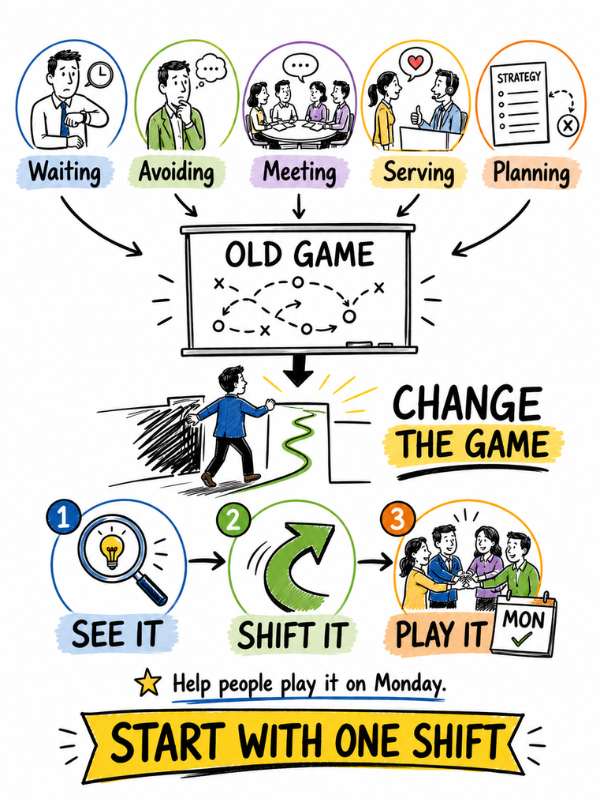
Topics don’t change leaders. Plays do.
A supervisor does not need a lecture on ownership. He needs to know what to do when his team waits for him to make the call.
A manager does not need another slide on coaching. She needs the words to use when someone is falling behind and the conversation feels uncomfortable.
A team does not need a longer meeting. They need a better play for deciding, owning, and moving.
That is how I design leadership training.
Not as more content to remember.
As practical plays leaders can use when the work gets real.
The format depends on the game they need to win.
Most training programs begin with the wrong question.
“What topic do you want?”
“How many hours do you have?”
“Do you want one day or two days?”
So the design follows the calendar.
One topic. One speaker. One deck. One day.
But leadership does not work that way.
A leader does not win because the topic was covered. A team does not move because the workshop lasted eight hours.
They win when they learn the right play, practice it, use the tool, and apply it when the work gets real.
That is why the format depends on the game they need to win.
Some leadership games can shift in 90 minutes.
A team can learn one play, practice it, and use it the next day.
Some need three hours because leaders must work through examples, try the tool, and prepare for real conversations.
Some need a full day because the play has many moving parts.
Some work best as two workshop days, especially when leaders need enough room to practice, reflect, and sharpen the next move. When the schedule allows, the two days can be spaced apart so they can try the play at work and return with real examples..
Others need a longer rhythm.
Start Supervising can be delivered as a four-week Shift30 online cohort for new supervisors.
Supervisor Effect can be delivered as a Shift45 program for supervisors who need deeper practice over time.
Whatever the format, the goal stays the same:
Teach the play.
Practice the play.
Use the tools.
Win the game at work.
Recommended Readings
How Leadership Training Should Work
Leadership training should not begin with a catalogue of topics. It should begin with the work that must change.
These articles explain how to diagnose the real problem, choose the right intervention, design practical learning, support workplace application, and look for proof that the training made a difference.
1. Before You Train, Ask What Keeps Happening
Start with the recurring workplace pattern. Find out what leaders keep doing, where the work gets stuck, and which moment the training must help them handle differently.
2. The ₱350,000 Time-Management Seminar That Changed Nothing
The requested topic is not always the real problem. A time-management issue may actually be caused by unclear priorities, broken processes, too many approvals, or work that should have been stopped.
3. The Three-Day Answer to an Eleven-Minute Problem
Not every leadership challenge needs a long program. Match the size of the intervention to the actual behavior, decision, or conversation leaders need to improve.
4. Active Training Is Not Enough
Games, discussions, and role plays can create energy without producing useful practice. Learn how to connect every activity to a real workplace moment, a better leadership move, and a clear performance standard.
5. Action Planning: Why Most Plans Fail Before Monday
An action plan should do more than record good intentions. It should identify the situation, the first move, the likely barrier, and the support participants need when they return to work.
6. Stop Training People to Survive Broken Systems
Training cannot repair contradictory targets, unclear authority, outdated processes, or ownerless work. Learn when to train, when to repair the system, and when both interventions must happen together.
7. One Step Away: The Goal Leaders Can Actually Move
Leadership training cannot guarantee a distant business result by itself. Define a closer result that leaders can influence, employees can observe, and the organization can inspect.
8. The Program Worked. The Work Did Not.
A well-run program can still fail to change the work. Attendance, satisfaction scores, and completed activities do not prove that decisions, conversations, handoffs, or results improved.
9. The Most Dangerous Training Program Is the One Everyone Likes
Positive reactions are useful, but applause is not the final measure. Look for practical plays, repeated application, manager support, and visible evidence that people now handle important situations differently.
Ready to explore the programs?
See the leadership training programs designed for high-potential employees, supervisors, managers, executives, and leadership teams.
What does a Leadership Shift Experience look like?
Some readers only need the program list. Others want to see how the experience works before they inquire.
So here is one example. It shows how we move leaders from activity to insight, from insight to practice, and from practice to proof at work.
First, they play the game.
The tennis ball looked harmless.
One small ball. One large tarp. Several holes cut into the cloth. The instruction was simple: move the ball from one end to the other without letting it fall.
At first, everyone laughed.
“Madali lang ’yan.”
Then the game started.
The tarp tightened. Hands pulled in different directions. Someone shouted, “Dahan-dahan!” Another said, “Sa kaliwa! Sa kaliwa!” A few people leaned forward, eyes locked on the ball. Others looked at the holes. Some waited for instructions. Some moved before the group was ready.
Then the ball dropped.
Everyone reacted at once.
“Hindi kasi sabay!”
“Masyadong mabilis!”
“Akala ko ikaw ang magle-lead!”
The room laughed again, but I let the moment sit for a few seconds.
Then, we debrief what really happened.
I asked, “What happened?”
At first, they talked about the game.
“We did not coordinate.”
“We moved without checking.”
“We saw the hole too late.”
“We assumed someone else was watching.”
So I asked the next question.
“Where does this happen at work?”
The room changed.
The laughter slowed down.
One person said, “When reports are delayed.”
Another said, “When a customer request is passed from one person to another.”
Someone added, “When everyone agrees in the meeting, but no one follows through.”
Then a manager said quietly, “Sometimes we already see the problem, but we wait for someone else to act.”
That was the shift.
They were no longer talking about a tennis ball.
They were talking about accountability.
Next, we name the old game.
I asked, “When the ball drops at work, what do people usually ask?”
They answered quickly.
“Who failed?”
“Who forgot?”
“Why did they not do it?”
“Who is responsible?”
I nodded.
Then I said, “Those questions may explain what happened. But they rarely move the work. Let us try a different set of questions.”
That was when I introduced the QBQ tool.
Instead of asking, “Who dropped the ball?” they practiced asking:
“What can I do now?”
“How can I help move this forward?”
“What must I clarify before this gets delayed?”
“Who needs to know before the customer gets affected?”
Then, they practice the better play.
We returned to their real workplace moments.
A delayed report.
A missed customer follow-up.
A handover that kept causing confusion.
A team member who waited instead of acting.
This time, they did not just discuss the problems. They practiced changing the language of the moment.
One participant tried a scenario.
“The report is delayed again. Usually, I ask, ‘Why is this always late?’”
I asked, “What is the better question?”
She paused.
Then she said, “What can I clarify today so this does not get delayed again?”
The group nodded.
Another participant said, “For customer follow-ups, instead of asking, ‘Who forgot to call?’ we can ask, ‘What can I do now so the customer gets an update before the day ends?’”
That was the play.
The activity created the energy.
The debrief revealed the real issue.
The tool gave them a new language.
The practice helped them use it before they returned to work.
Finally, the proof shows up at work.
One month later, HR told me what changed.
People followed up earlier. Delays were reduced. Team members showed more kusang-palo. Managers heard fewer excuses. Customers noticed faster responses.
That is what a Leadership Shift Experience is designed to do.
It does not stop at a fun activity.
It does not stop at a good insight.
It helps leaders see the game they are playing, practice a better play, and use a tool that changes what happens next.
The proof is not that people enjoyed the workshop.
The proof is that work moved after the workshop.
Who designs and delivers these leadership experiences?
I’m Jef Menguin.
I design leadership training for organizations that want people to lead better when the work gets real.
For more than two decades, I have worked with supervisors, managers, executives, teams, government agencies, schools, and companies across the Philippines.
But I do not design workshops to impress people in the room.
I design them to change what people do after the room.
That means we do not stop at ideas.
We find the stuck point. We name the old game. We teach the better play. We practice with real moments. Then we give leaders tools they can use when deadlines slip, meetings drift, people wait, customers feel forgotten, and strategy does not move.
That is the work.
Help leaders see the game.
Practice the better play.
Move the work.
Start with the stuck moment
You do not need to know the program yet.
Tell me what your leaders are struggling with now: unclear supervision, weak follow-through, slow decisions, avoided coaching conversations, or strategy that does not show up in daily work.
In a 20-minute Leadership Shift Call, we will find the real gap, name the first shift, and choose the best format — workshop, Shift30 challenge, Shift45 cohort, or custom experience.
This is not a sales presentation. It is a clarity call.
Book a 20-Minute Leadership Shift Call.