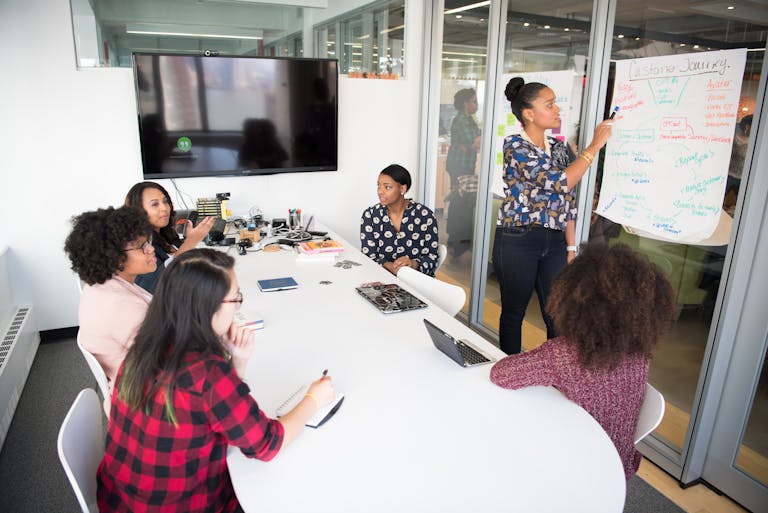
Think about the last time your organization had a “strategic planning” session.
Maybe you booked a nice venue. People wore smart casual. There were group activities, colored cards, and a big screen. At the end, someone sent a thick document or a long PDF called “Strategic Plan 2026–2028.”
For a while, it felt good. You had goals. You had timelines. You had projects.
But then Monday came.
Did people really work differently? Did they start saying no to some things so they could focus on better things? Did leaders let go of pet projects that did not fit the future you agreed on?
Or did most people just go back to the same habits, only with more things added to their to-do lists?
If that sounds familiar, you’re not alone. It happens in companies, schools, and government agencies all the time.
That’s why we need to face this simple truth:
Strategy is not a plan. Strategy is a choice.
Why We Keep Calling the Plan “Strategy”
Part of the problem comes from how we use words.
Many dictionaries say strategy is a plan or method to reach a goal. So leaders grow up thinking, “If we wrote a plan, then we already have a strategy.”
But a plan can be full of actions without any real choices.
You can plan to launch new products, open new branches, run new campaigns, and hire more people—and still never answer this question:
How will we win?
A plan tells you what you hope to do. A strategy tells you what you will choose so your organization has the best chance to win.
And when I say “win,” I don’t mean just a small gain in market share or being a little better than others. In business, I like to think of it this way:
Strategy is choosing to be so different and so valuable that customers almost beg to work with you.
That needs more than a schedule. It needs courage.
Strategy in the Spirit of Playing to Win
In the book Playing to Win, A.G. Lafley and Roger Martin give a clear and simple definition:
Strategy is a set of choices about how you will win.
They also offer five key questions to guide those choices:
- What is our winning aspiration?
- Where will we play?
- How will we win?
- What capabilities must be in place?
- What management systems do we need?
When I guide leaders, I use these five questions as a framework, not as a checklist.
Why? Because answering them on paper can be done very fast. A group of smart people can “fill in the blanks” in a few minutes. A tool like ChatGPT can create nice-sounding answers in seconds.
But that doesn’t mean the strategy is real.
Real strategy is not just the words you write. It’s the choices you’re willing to live with. It’s the things you are willing to give up and the habits you are willing to change.
That doesn’t happen in ten minutes.
Why Questions Alone Are Not Enough
In real life, changing the questions is not enough to change the strategy.
It helps. It opens the conversation. But it does not automatically change identity, mindset, and behavior.
Think about what happens when you talk about “where will we play” and “how will we win.”
On the whiteboard, people can agree. But deep inside, many leaders are attached to their projects. Some projects are their “babies.” They worked hard to create them. So when strategy requires them to let go, they defend these projects—sometimes very strongly.
Have you ever defended a project even when you knew, deep down, that it was not the best use of your organization’s time and money? Most of us have.
In government agencies, this is even more visible. Prioritizing one action often means other actions must be delayed or dropped. Yet each leader thinks, “Our project is different. It should not be touched.” They protect their own area instead of asking, “What will truly help our agency win for the people we serve?”
This is why I cannot just ask leaders the five questions and leave. We need tools and exercises that help them see their work differently, not just talk differently.
A Story: The Plan That Changed Nothing
Let me share a story.
I worked with an organization that proudly showed me their new “strategic plan.” It was detailed and looked very professional. It had market analysis, risk assessments, long tables, and many projects.
I asked the executive team a simple question:
“If we follow this plan, what will we stop doing?”
They looked at each other. After a short pause, someone smiled and said, “Actually, nothing. We just added more.”
So they didn’t really make choices. They tried to keep everything and please everyone. It looked like strategy, but their identity as leaders didn’t change. Their behaviors didn’t change. They were still trying to protect every project.
That is not playing to win. That is playing not to upset anyone.
Have you seen something similar where you work? Have you ever left a planning session thinking, “We agreed on many things, but I’m not sure what we are dropping”?
If yes, you know how heavy that feels.
The Same Group, Now Making Real Choices
With the same group, we tried something different.
We still used the five questions from Playing to Win, but we slowed down and used tools that made the choices feel real, not just theoretical.
First, we talked about winning. Not in vague words like “be number one,” but in specific terms. They said that winning meant becoming the most trusted partner for a certain type of client, in a certain region, with clear results that clients could feel.
Next, we explored “where will we play?” and we did not allow the easy answer “everywhere.” They had to decide which customers to focus on and which customers would not be their main focus. They also had to accept that some projects would no longer be central.
This part was emotional. You could see it in their faces when they realized that some of their favorite initiatives were not part of the future they wanted. But as the conversation went on, they started to see a bigger picture: if everything is a priority, then nothing truly is.
Then we talked about “how will we win?” We moved away from, “How do we keep up with others?” and shifted to, “How can we be so different and so valuable that the right customers are drawn to us?”
From there, the needed capabilities and systems became much clearer. It was easier to see what they had to build and what had to change.
By the end, instead of a thick plan full of everything, they had a simple, strong description of a small set of choices that worked together.
That’s when the strategy began to feel real.
Giving It a Name: Our Winning Play
Once those choices were clear, we wrote them on a short, clear document.
I like to call this document Our Winning Play.
Our Winning Play is not a long report. It is a simple page (or two) that shows:
- What “winning” looks like for us.
- Where we choose to play—and where we will not.
- How we choose to win in those spaces, in a way that is clearly different and valuable.
- What we must be very good at for this to work.
- What systems and routines will keep these choices alive.
“Our Winning Play” is meant to be read, remembered, and used. Leaders should be able to explain it without slides. Managers should be able to talk about it with their teams. People should be able to test their ideas against it and ask, “Does this fit Our Winning Play?”
It is more than a summary. It is a promise: “These are the choices we are willing to stand by. These are the things we will protect. These are the things we are willing to let go.”
The last part—letting go—is where identity and strategy meet. When a leader can say, “My project is less important than Our Winning Play,” that is a real shift.
Why This Work Takes Time
You might wonder, “If the five questions are simple, why does strategy take so much time?”
Because the questions are simple, but the tradeoffs are hard.
Writing answers can be quick. But doing the real work—arguing honestly, listening to others, challenging assumptions, facing data, and accepting that some ideas must end—takes time and courage.
That’s why, when I guide leaders, we use the five questions as a backbone, but we also use tools that create honest pressure:
- Tools that compare projects side by side.
- Tools that show what happens when we try to do everything.
- Tools that limit the number of things we can choose, so every yes feels serious.
These tools are not just activities. They are mirrors. They show who we really are when it is time to choose.
A Few Questions for You
Let me ask you, as if we’re talking over coffee.
If you look at your current “strategic plan,” can you clearly see your main choices? Or do you mostly see activities and projects?
If I asked ten of your managers, “How will we win?” do you think their answers would sound almost the same—or would you hear many different versions?
If you had to write Our Winning Play on one page today, what part would be the hardest to write? The “where we will play”? The “how we will win”? Or the part about what you are willing to stop?
You don’t need to answer me. But it’s worth answering for yourself.
A Simple First Step
Here’s one small step you can take this week.
Take your current plan. Don’t throw it away. Just set it aside for now.
On a clean sheet of paper, write in your own words:
- What does winning really mean for us?
- Where will we play? (Who are our key customers? Where are they? What offers matter most?)
- How will we win in a way that makes us truly different, not just slightly better?
- What do we need to be great at for this to work?
- What systems or routines will help us keep these choices alive?
Use plain language. Imagine you are explaining this to a new team member on their first day.
Then compare your answers with your current plan:
- What supports these choices?
- What doesn’t fit and may need to be reduced or stopped?
- What is missing?
From there, you can start building your first version of Our Winning Play. It won’t be perfect, and that’s okay. You can refine it with your leadership team, argue about it, and strengthen it.
What matters is that you move from “strategy as a document” to strategy as a set of living choices.
You can still have plans, timelines, and thick documents. Those are helpful tools.
But remember:
A plan tells you what you will do. A strategy tells you what you will choose.
When you start seeing strategy as a small set of brave choices that work together to help you win—and you capture those choices in Our Winning Play—your plans become sharper, your people become clearer, and your execution finally has a real chance to succeed.


If you’re building a business and you are playing to win…
Let’s install one shift that moves metrics.
→ Shift Experiences
