Use this when your week gets rewritten midstream and you’re tempted to freeze, complain, or overthink. You want to stay useful, calm, and effective even when nothing is stable. Stop fighting change. Start rebuilding your next step. Name what changed, choose what still matters, then move—small and steady.
Have you ever sat in a meeting where the plan looks clean… but everyone knows it won’t survive the week?
Someone says, “Let’s follow the process.” Someone else stays quiet, but you can feel the thought in the room: We’ve been following the process… and we’re still stuck.
That’s when the energy changes. Decisions slow down. Updates get longer. People stop offering ideas—not because they don’t care, but because they don’t want to hear “Not now” or “Next quarter” again.
The painful part is this: the leader is often competent, hardworking, and sincere.
But the world moved.
And their habits didn’t.
The leader who protects the past
Engr. Carlo Reyes, a Plant Manager in Laguna, ran a tight ship. He built routines, protected standards, and kept operations stable even when everything else felt unstable.
Then a new season arrived: tighter deadlines, new reporting expectations, new tools, new customer demands. Problems started showing up that didn’t fit the old playbook.
Carlo did what many strong leaders do under pressure. He protected what worked.
He tightened controls. He asked for more reports. He delayed changes until he could “make sure.”
One afternoon, a supervisor approached him.
“Sir, we can test a new handoff checklist. Five days lang.”
Carlo looked at the numbers, then at the team.
“Not yet,” he said. “Let’s stabilize first. We can’t risk mistakes.”
Carlo meant safety.
The team heard pause.
After that, people stopped suggesting improvements. Meetings got longer. Supervisors waited for approval. The plant stayed stable, but it stopped getting better.
The leader who trains for the present
Lea Santos, an Operations Manager, faced similar pressure. Her people were tired too. Priorities kept shifting. Tools kept changing.
In one meeting, a team lead asked, “Ma’am, do we stick to the old process? Or do we shift?”
Lea paused.
“Our goal stays,” she said. “But our approach needs an upgrade. Let’s try one change for five days. If it helps, we keep it. If it doesn’t, we learn and adjust.”
No drama. No speech.
Just a decision to learn.
That one move changed the team’s posture. They stopped treating change like a threat. They started treating it like a situation they could handle.
The moment you choose your posture
Here’s the shift. One shift only.
Don’t cling to what worked. Practice what works now.
A leader who clings keeps defending yesterday’s method. A leader who practices keeps choosing today’s next step.
And yes, this might be you. It might be the people you lead. It might be your boss. It might be someone you respect who built their reputation on strong routines—and now those routines feel heavy.
I’ve had my own version of it. There were seasons when I relied too much on what worked before—my usual format, my usual way of teaching, my usual way of explaining. Then the audience changed. The context changed. The world shifted. I had to stop asking, “How do I do this the old way, better?”
I had to ask, “What does this situation require now?”
Agility is not chaos. It’s speed with trust
People often call this agility. The word got popular because teams wanted to respond to change instead of clinging to plans.
In leadership terms, I use it simply: adaptability is the willingness to adjust. Agility is adjusting fast—without breaking trust.
That matters, because speed without trust feels reckless. But trust without speed becomes stagnation.
A small board that keeps you from freezing
A shift is easier when you have something you can hold.
That’s why worksheets work. They give you a script when emotions are loud and the room is tense.
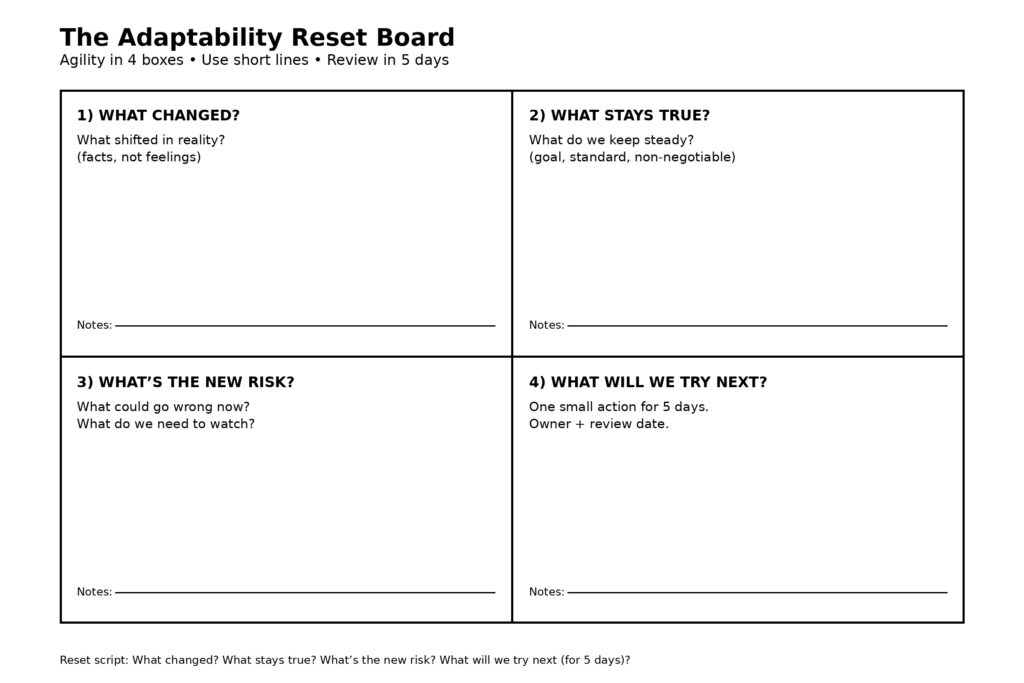
I call this one The Adaptability Reset Board (Agility in 4 Boxes). Use it when priorities shift, when a plan breaks, or when a meeting turns into a debate about the “old way.”
The Adaptability Reset Board
Mobile-friendly version (paste in chat):
- What changed?
- What stays true?
- What’s the new risk?
- What will we try next (for 5 days)?
- Owner:
- Review date:
If you prefer the worksheet layout, draw four boxes on paper and write short lines. Don’t write essays. The goal is movement.
Try this in your next meeting
When the room starts clinging or panicking, use this 1-minute script:
“Quick reset, team. What changed—facts only?”
“Okay. What stays true? What are we not changing?”
“What’s the new risk we need to watch?”
“So what will we try next for five days?”
“Who owns it?”
“When do we review and decide: keep, adjust, or drop?”
That’s agility without chaos.
Your next five days
Let’s say your client suddenly demands faster turnaround.
What changed? Delivery is now 48 hours, not 72.
What stays true? Quality stays. Safety stays.
What’s the new risk? Rushed handoffs may increase errors.
What will we try next? Pilot a tighter handoff checklist and a 10-minute end-of-shift review for five days. Supervisor Ana owns it. Review on Friday.
Notice what happened. Nobody argued about the past. Nobody panicked about the future.
You chose a test. You protected trust. You moved.
If you want to build this into your leadership culture
This isn’t just personal improvement. This is a team habit.
Meetings drag when people don’t share a simple way to respond to change. They either cling to the old way or they “pivot” randomly. The Reset Board gives leaders a repeatable method: name reality, protect what stays true, choose a small test, then review.
If you want to explore how to build this across leaders—so updates become clearer, decisions move faster, and teams learn without blame—you can contact me using the form on this page.
Your 24-hour push
Think of one change you’re dealing with right now: a new target, a new tool, a new process, a new expectation.
In the next conversation about that change, don’t explain more. Don’t defend the old way.
Pull out the Reset Board and ask the one question that creates movement:
“What will we try next—for five days?”
Because adaptability isn’t about abandoning what worked.
It’s about practicing what works now.








If your team is stuck in meetings, misalignment, or slow decisions…
Let’s design one shift they can use immediately.
→ Shift Experiences
